How to Scale Engineering Teams: Outpace Disruption with Proven Systems
Scale engineering teams effectively. Learn strategies for growing teams while maintaining culture, quality, and velocity.
Posted by
 Joseph Kaplan
Related reading
CTO Architecture Ownership at Early-Stage Startups: Execution Models & Leadership Clarity
At this stage, architecture is about speed and flexibility, not long-term perfection - sometimes you take on technical debt, on purpose, to move faster.
CTO Architecture Ownership at Series A Companies: Real Stage-Specific Accountability
Success: engineering scales without CTO bottlenecks, and technical strategy is clear to investors.
CTO Architecture Ownership at Series B Companies: Leadership & Equity Realities
The CTO role now means balancing technical leadership with business architecture - turning company goals into real technical plans that meet both product needs and investor deadlines.
Laying the Foundations for Scaling Engineering Teams
Successful scaling starts before the first new hire joins. Engineering leaders must first evaluate current capacity, establish technical standards that prevent future chaos, and ensure team boundaries match product architecture.
Assessing Organizational Context and Readiness
Engineering leaders should audit existing capacity before expanding headcount. This means reviewing deployment frequency, incident response times, and how much time engineers spend in meetings versus writing code. Teams losing more than 20% of productive time to coordination overhead aren't ready to scale.
The assessment should identify specific bottlenecks. Does QA block every release? Do database changes require three approvals? Is the CI/CD pipeline too slow? These constraints won't disappear with more people. They'll get worse.
Leadership must also evaluate whether current team structure supports growth. When to restructure engineering teams becomes clear when coordination costs exceed delivery output. If engineers can't ship features without talking to five other teams, organizational context needs fixing first.
Smart engineering leaders measure these dimensions with data, not assumptions. They track lead time for changes, change failure rates, and mean time to recovery before deciding to hire.
Defining Core Technical Principles and Documentation
Scalable architecture requires written technical principles that guide every design decision. These aren't abstract values. They're specific rules about service boundaries, data ownership, API contracts, and deployment patterns.
Documentation becomes infrastructure at scale. Engineering leaders should mandate architectural decision records for any change affecting multiple teams. These records explain what was decided, why alternatives were rejected, and what constraints influenced the choice.
The goal is reducing repeated conversations. When ten engineers ask "should we use REST or GraphQL," a documented principle with context gives them an answer without scheduling meetings. This prevents the cognitive load that kills velocity in growing organizations.
Technical standards also cover observability, security, and error handling. Every service should emit structured logs. Every API should return consistent error codes. Every deployment should include rollback procedures. Codeinate breaks down how leading teams codify these patterns into reusable templates that accelerate delivery without compromising quality.
Aligning Teams with Product and Architecture
Team structure must mirror product architecture. When organizational boundaries don't match technical boundaries, engineers waste time coordinating across artificial divides.
Strategic team topologies provide a framework for this alignment. Stream-aligned teams own complete user journeys from frontend to database. Platform teams build internal services that multiple stream-aligned teams consume. Enabling teams help others adopt new capabilities without creating dependencies.
Each team should control its own deployment pipeline and data stores. Shared databases create coupling that slows everyone down. Shared services create bottlenecks that multiply as teams grow.
Engineering leadership must also define clear interfaces between teams. Service contracts, API specifications, and event schemas become the boundaries that let teams work independently. Without these boundaries, scaling just creates a bigger monolith with more meetings.
Strategically Designing Scalable Team Structures
Wake Up Your Tech Knowledge
Join 40,000 others and get Codeinated in 5 minutes. The free weekly email that wakes up your tech knowledge. Five minutes. Every week. No drowsiness. Five minutes. No drowsiness.

Effective team structures reduce coordination overhead, preserve delivery speed, and prevent the communication breakdowns that typically emerge when engineering organizations grow beyond 20 people. Structuring engineering teams for long-term velocity requires clear ownership models, bounded contexts, and intentional cognitive load management.
Implementing Team Topologies and Boundaries
Engineering leaders must move beyond ad-hoc squad formations and adopt structured topologies that align with product boundaries. The Team Topologies framework identifies four core team types: stream-aligned teams that own specific user journeys, platform teams that build internal tooling, enabling teams that diffuse knowledge across the organization, and complicated subsystem teams that handle specialized technical domains.
Stream-aligned teams should represent 80% of the engineering organization. These teams own a single product feature or customer flow from concept to production, minimizing handoffs and dependencies. Platform teams emerge when multiple stream-aligned teams face identical pain points around deployment, observability, or data infrastructure. Engineering leaders create enabling teams during periods of rapid technology adoption or skill gaps, tasking them with accelerating capability transfer rather than centralizing ownership.
Complicated subsystem teams remain the rarest topology. They handle technical domains requiring deep specialization that cannot be easily distributed across stream-aligned teams. Examples include recommendation engines, fraud detection systems, or real-time video processing pipelines. These teams maintain clear interfaces with stream-aligned teams to prevent becoming bottlenecks.
Managing Cognitive Load
Cognitive load determines whether engineers ship features or drown in complexity. High cognitive load manifests as increased cycle times, elevated defect rates, and engineer burnout. Engineering leaders must actively measure and reduce the intrinsic, extraneous, and germane cognitive load their teams carry.
Intrinsic load stems from the inherent complexity of the work itself. Leaders reduce it by breaking monolithic services into bounded contexts, limiting the number of services a single team maintains, and establishing clear API contracts between teams. A practical threshold: if a team owns more than three services or supports more than two distinct user journeys, cognitive load likely exceeds sustainable levels.
Extraneous load comes from toolchain sprawl, inconsistent processes, and unclear ownership boundaries. Engineering teams lose up to 20% of their time navigating toolchain complexity, particularly when juggling six or more development tools. Leaders audit their technology stack quarterly, consolidating overlapping tools and standardizing workflows across teams. Codeinate tracks how high-performing organizations benchmark tool selection and measure the productivity impact of platform consolidation decisions.
Building Cross-Functional Teams
Cross-functional teams bundle all skills needed to deliver customer value without external dependencies. Each team includes frontend and backend engineers, a product manager, a designer, and embedded quality engineering expertise. This structure eliminates the handoff delays that plague functionally-siloed organizations.
Engineering leaders staff cross-functional teams with a stable core of five to eight people. Teams smaller than five lack sufficient skill coverage. Teams larger than eight experience communication overhead that negates the benefits of co-location. The team maintains stable membership for at least six months, allowing them to develop shared context and predictable delivery rhythms.
Scalable engineering teams require embedded technical leadership within each cross-functional unit. Tech leads or staff engineers provide architectural guidance, maintain code quality standards, and serve as the escalation point for technical decisions. They attend cross-team architectural reviews to ensure individual team decisions align with broader system design patterns. This distributed leadership model scales more effectively than centralized architecture committees, which become bottlenecks as the organization grows.
Optimizing Talent Acquisition, Onboarding, and Mentoring
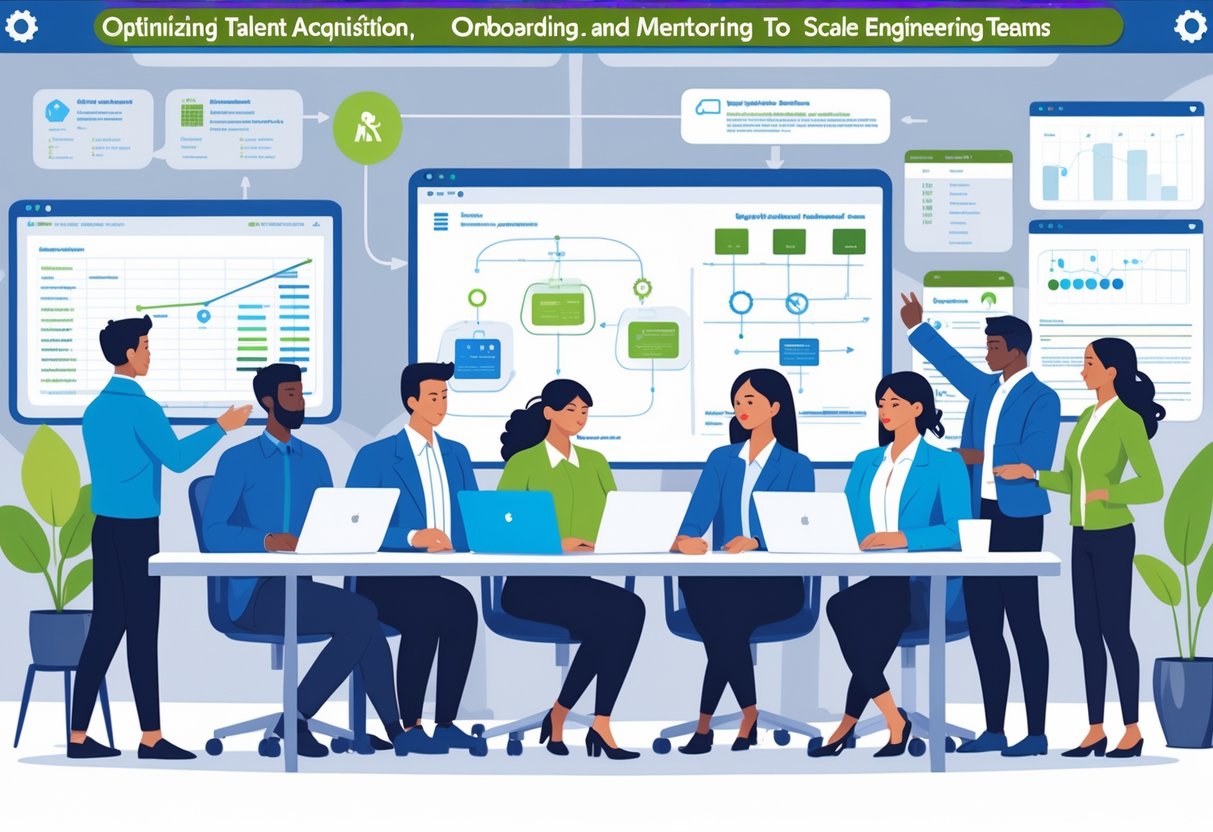
Scaling engineering teams requires structured approaches to finding technical talent, integrating new hires into existing systems, and building knowledge transfer mechanisms that preserve institutional expertise. The following subsections address recruitment pipelines, onboarding frameworks, and mentorship structures that engineering leaders use to maintain code quality and team velocity during growth phases.
Scaling Recruitment and Talent Sourcing
High-performing engineering organizations build talent acquisition strategies that align with technical roadmap requirements rather than reactive hiring. Engineering leaders map skill inventories against upcoming architecture decisions - microservices migrations, AI model deployment, or infrastructure-as-code implementations - to identify gaps before they block deliverables.
Effective sourcing channels include:
- Employee referral programs with technical assessment criteria
- Open-source contribution tracking for passive candidates
- University partnerships focused on specific language ecosystems
- Technical community engagement at conferences and hackathons
Skills-based hiring practices focus on demonstrated capabilities through coding assessments and system design exercises rather than credential filtering. Engineering leadership defines evaluation rubrics that test for architectural thinking, debugging methodology, and collaboration patterns. Teams that integrate data analytics into recruitment track time-to-hire metrics, interview-to-offer ratios, and source effectiveness to optimize pipeline conversion.
Job descriptions should specify technology stacks, deployment environments, and code review practices. This precision attracts candidates who understand the technical context and reduces misalignment during interviews.
Effective Onboarding Process Design
Structured onboarding processes reduce time-to-first-commit and accelerate integration into development workflows. Engineering teams build documented pathways that cover repository access, local environment setup, CI/CD pipeline navigation, and code ownership models within the first week.
The most effective onboarding frameworks include:
| Phase | Activities | Timeline |
|---|---|---|
| Pre-start | Hardware provisioning, credential setup, documentation access | Week -1 |
| Technical setup | Dev environment configuration, build system verification, test suite execution | Days 1-3 |
| Codebase orientation | Architecture walkthroughs, service dependency mapping, observability tools | Days 4-7 |
| First contributions | Bug fixes, documentation updates, test coverage improvements | Weeks 2-4 |
Engineering leaders assign starter tasks that touch multiple parts of the system to build mental models of component interactions. New hires should deploy code to staging environments within two weeks to understand release processes and rollback procedures.
Documentation must cover architectural decision records, API contracts, database schemas, and incident response protocols. Teams using internal wikis or knowledge bases reduce repetitive questions and preserve tribal knowledge as headcount grows.
Establishing Mentorship Programs
Mentorship programs pair new engineers with experienced team members who provide technical guidance, code review feedback, and cultural context. Engineering leadership assigns mentors based on domain expertise alignment and communication style compatibility rather than arbitrary team boundaries.
Effective mentorship structures include weekly one-on-ones, pair programming sessions on complex features, and shadowing during on-call rotations. Mentors help new hires navigate technical debt decisions, understand performance optimization trade-offs, and learn debugging techniques specific to the production environment.
Key mentorship responsibilities:
- Reviewing pull requests with architectural feedback
- Explaining system behavior during incident investigations
- Introducing new hires to cross-functional stakeholders
- Providing context on legacy code decisions
Organizations track mentorship effectiveness through retention rates, promotion velocity, and code quality metrics for mentored engineers versus those without formal support. Engineering leaders allocate 10-15% of senior engineer time to mentorship activities and include mentoring contributions in performance evaluations.
Codeinate breaks down how leading engineering organizations structure career ladders, knowledge-sharing frameworks, and technical mentorship programs that scale beyond 100 engineers while maintaining code quality standards.
Establishing Robust Engineering Processes and Automation
Engineering processes determine whether teams scale smoothly or collapse under their own weight. Standardized workflows reduce cognitive load, automation reclaims engineering time, and systematic test coverage protects velocity as codebases grow.
Standardizing Engineering Workflows
Teams that lack standard workflows waste hours reconciling different approaches to code review, deployment, and incident response. Engineering leadership should define clear paths for common activities: how code moves from branch to production, how teams escalate blockers, and how decisions get documented.
A standardized code review process sets expectations for turnaround time, approval requirements, and feedback format. High-performing teams typically require one approval for low-risk changes and two for database migrations or API contracts. They also set explicit service-level objectives for review latency - often 24 hours for routine pull requests.
When to introduce processes becomes critical as teams grow. Introducing rigid structure too early stifles creativity. Waiting too long creates chaos. The inflection point usually arrives when the same coordination failure happens three times in one quarter.
Documentation standards prevent knowledge from residing in a single engineer's head. Teams should define where design decisions live, how runbooks get maintained, and who owns keeping critical documentation current. Without this, onboarding stretches from weeks to months.
Leveraging Automation for Productivity
Engineers lose up to 20% of their time to repetitive tasks that machines handle better. Automated testing pipelines catch regressions before code review begins. Automated deployment tools eliminate manual release checklists. Automated monitoring alerts teams to incidents before customers report them.
Wake Up Your Tech Knowledge
Join 40,000 others and get Codeinated in 5 minutes. The free weekly email that wakes up your tech knowledge. Five minutes. Every week. No drowsiness. Five minutes. No drowsiness.
Continuous integration runs tests on every commit, preventing broken code from reaching main branches. Continuous deployment pushes approved changes to production without manual intervention. These practices reduce deployment frequency from weekly rituals to multiple times per day.
Infrastructure as code replaces manual server configuration with version-controlled templates. When teams provision resources through code, they eliminate configuration drift and make environments reproducible. This approach also creates an audit trail for every infrastructure change.
Automation and scalable processes help distributed teams coordinate without constant meetings. Automated status updates replace daily standups. Automated dependency checks prevent teams from shipping incompatible versions.
Maintaining Test Coverage and Quality
Test coverage drops during rapid growth unless teams treat it as infrastructure. Every new feature should include unit tests for logic, integration tests for service boundaries, and end-to-end tests for critical user paths. Teams that skip testing to move faster create technical debt that eventually halts all progress.
Unit tests validate individual functions in isolation. They run in milliseconds and give engineers immediate feedback. Integration tests verify that services communicate correctly. End-to-end tests confirm complete user workflows but run slower and require careful maintenance.
Code coverage metrics provide visibility but don't guarantee quality. A codebase with 90% coverage can still harbor critical bugs if tests don't assert the right conditions. Engineering leadership should review both coverage percentages and test effectiveness during architecture reviews.
Automated quality gates block deployments when test suites fail or coverage drops below thresholds. This prevents teams from bypassing standards during crunch periods. The gates should run in continuous integration pipelines, giving engineers feedback within minutes of pushing code.
Architecting for Scale: Systems and Technical Strategy

System architecture determines how easily engineering teams can scale without creating bottlenecks. The right technical decisions enable parallel work across growing teams while preventing the coordination overhead that slows larger organizations.
Adopting Scalable Architecture Patterns
Scalable architecture decisions made early determine growth capacity for years. Teams need clear boundaries between components to enable parallel development. Domain-driven design creates natural divisions that align with business capabilities.
Service boundaries should match team boundaries. When a component maps to a single team, coordination costs drop significantly. Teams can deploy independently without waiting for other groups.
Key architectural patterns that support scaling include:
- Event-driven architectures for loose coupling between services
- API contracts that define clear interfaces between components
- Modular monoliths that separate concerns without microservices complexity
- Database-per-service patterns that prevent data coupling
Top engineering organizations evaluate these patterns based on team size and domain complexity. A 10-person team rarely needs the overhead of full microservices. A 50-person team struggles with a tightly coupled monolith.
Microservices and Modular Systems
Microservices architecture enables teams to work independently but introduces operational complexity. Organizations should adopt microservices when team size exceeds 20-25 engineers. Smaller teams benefit more from modular monoliths with clear internal boundaries.
Each microservice needs its own deployment pipeline, monitoring, and operational tooling. This overhead multiplies across services. Teams must balance autonomy against operational burden.
Critical microservices considerations:
| Factor | Impact on Scaling |
|---|---|
| Service granularity | Too small creates coordination overhead; too large limits autonomy |
| Data consistency | Distributed transactions add complexity and failure modes |
| Operational tooling | Each service requires monitoring, logging, tracing |
| Team ownership | Clear service ownership prevents responsibility diffusion |
The most effective approach starts with a modular monolith and extracts services when team boundaries solidify. This prevents premature optimization while maintaining flexibility.
Managing Technical Debt
Technical debt accumulates faster as teams grow. Managing technical debt systematically prevents productivity collapse. Engineering leaders should allocate 15-20% of sprint capacity to debt reduction.
Debt becomes visible through velocity metrics and incident frequency. Teams that defer maintenance see deployment frequency drop and bug rates increase. The cost of change rises exponentially.
Effective debt management requires:
- Quarterly debt audits that classify issues by business impact
- Architectural decision records that document trade-offs
- Refactoring sprints dedicated to structural improvements
- Automated quality gates that prevent new debt introduction
Fortune 500 CTOs track debt as a financial metric, measuring the cost to resolve versus the productivity impact. This quantification helps justify maintenance investment to business stakeholders.
Driving High Performance and Team Collaboration
Cross-functional alignment and data-driven performance management determine whether scaling efforts multiply output or create bottlenecks. Organizations that establish structured collaboration practices, track meaningful delivery metrics, and build systems for distributing knowledge across teams maintain velocity as headcount increases.
Building Cross-Team Collaboration Practices
Stream-aligned teams own specific product areas, but dependencies between teams create natural friction points that slow delivery. Scaling engineering teams leads to more silos and disconnection without intentional coordination mechanisms.
Platform teams reduce this friction by providing internal services that multiple stream-aligned teams consume. Rather than each team building authentication, deployment pipelines, or observability tooling independently, platform teams create standardized solutions. This eliminates duplicate work and reduces cognitive load.
Collaboration rituals that work at scale include:
- Weekly cross-team sync meetings focused on dependency resolution rather than status updates
- Shared on-call rotations that expose engineers to adjacent systems
- Architecture review boards that evaluate proposals affecting multiple teams
- Regular demos where teams showcase work to the broader engineering organization
Engineers who understand systems beyond their immediate scope make better architectural decisions. Cross-team rotation programs place engineers on different teams for three to six month periods, building relationships and distributing system knowledge organically.
Implementing Performance Metrics and KPIs
Teams without measurable objectives experience 40% lower goal attainment. Strategic frameworks for scaling require performance metrics that expose bottlenecks before they compound.
DORA metrics provide the foundation:
| Metric | Elite Target | What It Reveals |
|---|---|---|
| Deployment frequency | Multiple times per day | Release process efficiency |
| Lead time for changes | Less than one hour | End-to-end workflow speed |
| Change failure rate | Less than 5% | Quality of testing and deployment practices |
| Mean time to restore | Less than one hour | Incident response effectiveness |
Engineering leaders track these metrics per team rather than aggregating across the organization. Aggregation hides variance and prevents targeted intervention.
Beyond DORA metrics, cycle time distribution matters more than averages. If most pull requests merge in two hours but 10% take three days, the tail indicates either unclear requirements, knowledge silos, or architectural complexity. Top teams instrument their development workflow to identify these outliers systematically.
Promoting Knowledge Sharing
Documentation decay creates knowledge silos that limit team autonomy. When only two engineers understand the payment system, those engineers become bottlenecks for any payment-related work.
Architecture decision records capture the reasoning behind technical choices. Each ADR documents the context, options considered, decision made, and expected consequences. Engineers joining the team six months later understand why the system looks the way it does without interrupting teammates.
Runbooks transform tribal knowledge into operational procedures. Rather than relying on specific engineers during incidents, runbooks document diagnostic steps, rollback procedures, and escalation paths. Teams that maintain current runbooks restore service faster and distribute on-call burden more evenly.
Lunch-and-learn sessions where engineers present technical topics build shared context across teams. These sessions work best when presenters focus on decisions and trade-offs rather than surface-level overviews. An engineer explaining why the team chose PostgreSQL over DynamoDB for a specific use case provides more value than a generic database comparison.
Scaling Distributed and Global Engineering Teams

Global teams unlock access to specialized talent and can reduce costs by 30-40%, but only when engineering leadership builds intentional structures for asynchronous work and maintains cultural cohesion across time zones.
Best Practices for Distributed Teams
Successful distributed engineering teams require different operating models than co-located groups. Communication must shift from synchronous to asynchronous by default, with clear documentation becoming infrastructure rather than an afterthought.
Key operational changes for distributed teams:
- Documentation-first workflow: All decisions, architecture discussions, and sprint planning must be written in a central system before meetings occur
- Overlap windows: Teams should identify 2-3 hours of daily overlap across time zones for real-time collaboration on blockers
- Tool consolidation: Distributed teams using six or more tools lose up to 20% of productivity to context switching and integration overhead
Engineering leadership must establish decision-making frameworks that prevent distributed teams from waiting on approvals. Leading global engineering operations requires balancing asynchronous communication with decisive action, transforming geographical distance into a strategic advantage rather than a coordination burden.
The organizational context matters significantly. Teams without clear ownership boundaries experience higher cognitive load and slower delivery times, making team structure design essential before adding distributed engineers.
Fostering Engineering Culture at Scale
Culture deteriorates faster in distributed teams when left unmanaged. Engineering leadership must create explicit rituals and shared practices that replace the informal interactions of office environments.
High-performing distributed teams implement structured connection points:
- Weekly team demos where engineers showcase work regardless of completion status
- Monthly rotating "culture leads" who organize virtual team activities
- Quarterly in-person gatherings focused on relationship building rather than project work
Recognition systems need redesign for distributed contexts. Public acknowledgment in shared channels, peer-nominated awards, and transparent career progression frameworks become critical when managers cannot observe daily contributions directly.
Onboarding requires particular attention. New distributed engineers should receive structured 30-60-90 day plans with explicit checkpoints, assigned mentors in their time zone, and regular feedback loops. Teams that invest in comprehensive remote onboarding see 25% higher retention rates in the first year compared to those using ad-hoc approaches.
Wake Up Your Tech Knowledge
Join 40,000 others and get Codeinated in 5 minutes. The free weekly email that wakes up your tech knowledge. Five minutes. Every week. No drowsiness. Five minutes. No drowsiness.