Prioritization Frameworks for Engineers: Systems Thinking For Technical Teams
Master prioritization frameworks for engineering work. Learn how to evaluate trade-offs and make data-driven decisions about what to build next.
Posted by
 Joseph Kaplan
Related reading
CTO Architecture Ownership at Early-Stage Startups: Execution Models & Leadership Clarity
At this stage, architecture is about speed and flexibility, not long-term perfection - sometimes you take on technical debt, on purpose, to move faster.
CTO Architecture Ownership at Series A Companies: Real Stage-Specific Accountability
Success: engineering scales without CTO bottlenecks, and technical strategy is clear to investors.
CTO Architecture Ownership at Series B Companies: Leadership & Equity Realities
The CTO role now means balancing technical leadership with business architecture - turning company goals into real technical plans that meet both product needs and investor deadlines.
Core Principles of Prioritization for Engineers
Engineers face constant tension between what needs immediate action and what drives lasting value. Effective prioritization requires distinguishing between reactive firefighting and strategic execution while ensuring every decision supports measurable business outcomes and optimizes scarce engineering capacity.
Balancing Urgency and Importance
Engineers often confuse urgency with importance, treating every incoming request as critical. True prioritization separates tasks that appear pressing from those that genuinely impact system reliability, customer value, or revenue.
The Eisenhower Matrix helps engineering leaders categorize work into four quadrants: urgent and important, important but not urgent, urgent but not important, and neither. Production incidents fall into the first category and demand immediate response. Technical debt that threatens system scalability belongs in the second quadrant and requires scheduled attention before it becomes urgent.
Many teams waste capacity on the third quadrant - requests that feel urgent but deliver minimal impact. A senior engineer might spend hours debugging a cosmetic UI issue flagged by a single user while ignoring database query optimization that affects thousands. Distinguishing these categories prevents reactive work from consuming strategic capacity.
Setting clear severity levels helps teams respond appropriately. Critical issues affecting revenue or security require immediate action. Non-critical bugs affecting small user segments can wait for regular sprint planning. This structured approach reduces context switching and protects focus time for high-leverage work.
Aligning With Business Goals
Every engineering decision should trace back to concrete business objectives. When engineers prioritize features, architecture changes, or platform improvements without understanding company goals, they risk building technically impressive solutions that miss the mark.
Effective prioritization frameworks connect engineering work directly to metrics like customer acquisition cost, retention rates, or operational efficiency. An e-commerce platform might prioritize checkout optimization over admin panel features because conversion rate directly impacts revenue. A B2B SaaS company might focus on API reliability over new features because enterprise customers demand 99.9% uptime.
Engineers should ask specific questions before committing resources. Does this work reduce customer churn? Does it enable sales to close larger deals? Does it decrease infrastructure costs? Without clear answers, the work likely doesn't align with business priorities.
Cross-functional alignment requires regular communication between engineering, product, and executive leadership. High-performing teams establish shared metrics and review prioritization decisions quarterly. This prevents engineering from optimizing for technical elegance while the business needs speed to market, or vice versa.
Resource Allocation Strategies
Engineering capacity remains the most constrained resource in technology organizations. Teams must allocate developer time, infrastructure budget, and attention across competing demands: new features, technical debt, reliability improvements, and operational support.
Leading engineering organizations typically reserve 20-30% of sprint capacity for technical debt and infrastructure work. This prevents the accumulation of shortcuts that eventually freeze development velocity. Teams that defer all maintenance work eventually spend more time fighting legacy systems than building new capabilities.
Resource allocation requires hard trade-offs. A team cannot simultaneously ship aggressive feature timelines, maintain high code quality, and provide 24/7 on-call support without burning out. Engineering managers must explicitly choose where to invest limited capacity based on current business needs.
Stack ranking forces absolute prioritization when resources are tight. Each initiative receives a unique priority number, eliminating the trap of labeling everything as high priority. The top three items get resources; everything else waits. This clarity prevents teams from context-switching across ten parallel initiatives and delivering none well.
Infrastructure decisions materially impact resource allocation. Choosing managed services over self-hosted solutions trades higher operational costs for reduced engineering overhead. Adopting AI-assisted coding tools shifts capacity from routine implementation toward architecture and problem-solving. These choices compound over time, either freeing up or consuming engineering capacity.
Decision-Making Foundations in Engineering Prioritization
Wake Up Your Tech Knowledge
Join 40,000 others and get Codeinated in 5 minutes. The free weekly email that wakes up your tech knowledge. Five minutes. Every week. No drowsiness. Five minutes. No drowsiness.
Engineers face constant trade-offs between speed and quality, technical debt and new features, and immediate fixes versus long-term architecture improvements. The foundation of effective prioritization rests on building pattern recognition through experience, balancing quantitative metrics with qualitative judgment, and ensuring all parties agree on what matters most.
Building Intuition and Credibility
Engineering intuition develops through repeated exposure to similar technical decisions and their downstream consequences. An engineer who has debugged three database bottlenecks recognizes the warning signs faster than someone reading documentation for the first time. This pattern recognition accelerates decision speed without sacrificing accuracy.
Confidence level grows when predictions match outcomes. Engineers who estimate a refactoring will take two weeks and deliver in that timeframe build trust with their teams and stakeholders. Those who consistently miss estimates erode their influence in prioritization discussions.
Senior engineers develop intuition by tracking decisions over time. They note which architectural choices created maintenance burdens six months later and which quick fixes actually solved problems permanently. Teams that document these outcomes create institutional knowledge that newcomers can leverage. High-performing engineering organizations formalize this learning through post-mortems and technical retrospectives that connect past decisions to current system behavior.
Data-Driven Versus Gut-Based Choices
Effective engineering decision-making requires balancing quantitative metrics with qualitative judgment. Production metrics reveal which services crash most frequently. Error logs show which API endpoints return the most failures. User analytics demonstrate which features drive retention.
However, data alone misses context. A service with high error rates might serve a deprecated feature with minimal business impact. A slow database query might only affect internal tools used by three people.
Engineers combine metrics with business understanding:
- Traffic patterns indicate user behavior but not user intent
- Performance benchmarks show speed but not perceived value
- Code complexity scores measure technical debt but not actual maintenance cost
The strongest technical decisions merge both approaches. An engineer reviews incident frequency data, then asks which incidents caused customer escalations or revenue loss. Another examines code coverage percentages, then identifies which untested modules sit in critical payment flows. This dual-lens approach prevents optimizing metrics that don't matter while ignoring problems that do.
The Role of Stakeholder Alignment
Technical priorities fail when engineers, product managers, and business leaders disagree on what urgent means. An engineer might prioritize database optimization while product demands new features and executives worry about compliance deadlines.
Smart prioritization frameworks require explicit agreement on evaluation criteria before ranking tasks. Teams establish shared definitions for severity levels, effort estimates, and business impact categories.
When stakeholders align on these definitions upfront, prioritization discussions focus on categorizing specific tasks rather than debating philosophies. An incident becomes P0 or P1 based on agreed rules, not whoever argues loudest. A feature lands in the current sprint or next quarter based on transparent value-versus-effort assessment.
Engineers who involve stakeholders in framework design gain buy-in for resulting decisions. A product manager who helped define "high value" accepts why their feature ranks below another. An executive who reviewed severity definitions understands why engineers prioritize security patches over new capabilities. This alignment transforms prioritization from political negotiation into systematic evaluation.
Effort, Complexity, and Technical Feasibility
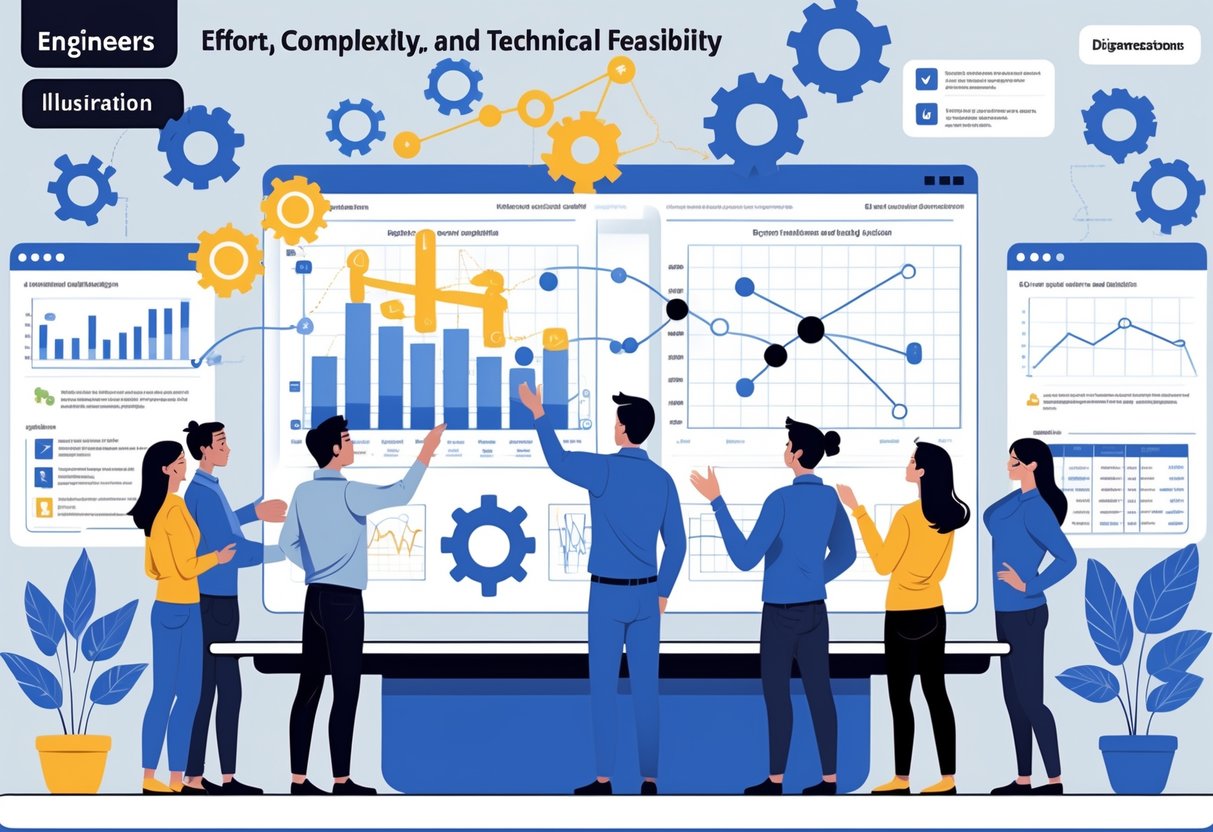
Engineers face constant pressure to estimate work accurately while balancing technical risk against delivery speed. The relationship between effort and complexity determines whether a project becomes a quick win or a multi-quarter investment that drains resources.
Evaluating Technical Complexity
Technical complexity measures the difficulty, risk, and uncertainty inherent in a task rather than just the time required. A task might need only two days but involve unfamiliar APIs, distributed state management, or cross-service dependencies that create hidden risks.
High-performing teams evaluate complexity by examining several factors:
- Dependencies: Number of external services, teams, or systems involved
- Unknowns: Areas requiring research, proof-of-concept work, or experimentation
- Technical depth: Need for specialized knowledge or rare expertise
- Risk surface: Potential for cascading failures or difficult rollbacks
When evaluating tasks based on complexity and effort, engineers should distinguish between problems that are hard to solve versus problems that simply take time. A database migration might be low complexity but high effort. Building a new consensus algorithm is high complexity regardless of effort.
Assessing Effort and Feasibility
Effort represents the actual time, energy, and resources needed to complete work. Technical feasibility asks whether the work can be accomplished with current tools, skills, and constraints.
Teams assess effort by breaking work into concrete units. A task requiring 40 hours of focused coding is different from one needing 40 hours spread across coordination, reviews, and testing. Calendar time often exceeds engineering time by 2-3x when accounting for meetings, context switching, and dependencies.
Feasibility requires honest evaluation of team capabilities and infrastructure readiness. Can the existing architecture support the change? Does the team have the right skills, or will they need ramp-up time? Fortune 500 engineering leaders regularly benchmark their tool-chain against modern alternatives to avoid false feasibility assumptions based on outdated capabilities.
Managing Technical Debt and Risks
Strategic prioritization frameworks help teams balance new features against technical debt. Every high-effort, high-complexity task creates future maintenance burden that compounds over time.
Engineers manage this by categorizing debt into three types:
- Intentional debt: Shortcuts taken knowingly to ship faster
- Accidental debt: Poor decisions made without full context
- Environmental debt: Code that was fine but became problematic as systems evolved
Smart teams allocate 15-20% of sprint capacity to debt reduction. They focus on debt that blocks high-value work or increases the complexity of future changes. A brittle integration layer that makes every new feature harder is worth fixing. Cosmetic code cleanup rarely is.
Risk management requires explicit tracking of technical unknowns. Teams that surface complexity early can pivot, reduce scope, or allocate more senior resources before timelines slip.
Overlay of Prioritization Frameworks for Engineers

Different frameworks solve different problems, and engineers who master when to apply each model - and how to layer them together - make faster, more defensible decisions under constraint.
Choosing the Right Framework
Engineers face different types of decisions throughout a project lifecycle. MoSCoW works best for MVPs and fixed-scope projects where teams need to distinguish release blockers from nice-to-haves. Stack ranking forces absolute ordering when deadlines loom and every task competes for the same limited sprint capacity.
The Value-Effort matrix suits technical debt decisions and architecture improvements where teams must compare items with uncertain payoffs. Severity-frequency models drive incident management with predefined rules that remove ambiguity during outages. The Eisenhower matrix helps individual contributors and managers separate daily task urgency from strategic importance.
Teams that pick frameworks based on context - not habit - avoid the common trap of treating all requests as isolated silos. Product management benefits when engineers communicate which framework guided their prioritization, making trade-offs visible across functions.
Wake Up Your Tech Knowledge
Join 40,000 others and get Codeinated in 5 minutes. The free weekly email that wakes up your tech knowledge. Five minutes. Every week. No drowsiness. Five minutes. No drowsiness.
Combining Multiple Models
High-performing teams layer frameworks to create multi-dimensional views of their backlog. An engineering manager might use MoSCoW to establish feature tiers, then apply Value-Effort mapping within the "Should-have" bucket to sequence work by implementation cost.
Project prioritization often combines stack ranking for roadmap ordering with severity-frequency rules for production issues that interrupt planned work. This dual-layer approach prevents teams from getting stuck between competing priorities when incidents force replanning.
Engineers can run the Eisenhower matrix on personal tasks while their team uses Value-Effort for backlog grooming. The frameworks operate at different altitudes without conflict. Teams that document which frameworks apply to which decision types build repeatable processes that scale beyond individual knowledge.
Key Prioritization Models and Matrices
Engineers need systematic frameworks to evaluate competing tasks and allocate resources effectively. The Eisenhower Matrix separates urgency from importance, while MoSCoW forces clear boundaries between critical and optional scope, and Weighted Shortest Job First integrates cost of delay into engineering execution decisions.
Complexity vs. Effort Matrix
The Complexity vs. Effort Matrix maps technical work across two dimensions: implementation effort and architectural complexity. Engineers place each task on a quadrant grid to identify quick wins versus high-investment initiatives.
Low effort, low complexity tasks deliver immediate value with minimal resource commitment. These typically include configuration changes, feature flags, or straightforward bug fixes. High effort, high complexity work requires dedicated planning cycles and often involves cross-team dependencies or fundamental architecture shifts.
Teams use this matrix during sprint planning and quarterly roadmap reviews. The framework reveals when seemingly simple requests carry hidden complexity that demands architecture review. It also exposes opportunities where modest effort unlocks disproportionate impact.
The matrix works best when engineers calibrate complexity against existing system knowledge rather than abstract difficulty. A task may require high effort but low complexity if the team has solved similar problems before. This distinction prevents roadmap bloat from familiar but time-intensive work.
Eisenhower Matrix
The Eisenhower Matrix divides tasks into four categories based on urgency and importance. Important and urgent tasks demand immediate attention, such as production incidents or security vulnerabilities. Important but not urgent work includes technical debt reduction, architecture improvements, and strategic refactoring.
Not important but urgent tasks often arrive as interruptions. Engineers should delegate these or batch them into focused time blocks. Not important and not urgent items belong in the backlog or get discarded entirely.
Engineering managers apply this framework to protect deep work time. They identify which "urgent" requests actually lack strategic importance. This prevents reactive work from consuming capacity needed for platform improvements.
The framework fails when teams misclassify tasks. A database migration might seem non-urgent until it blocks multiple feature teams. Engineers must regularly reassess categories as system constraints evolve and technical debt accumulates.
MoSCoW Method
The MoSCoW Method categorizes work into Must-have, Should-have, and Could-have buckets. Must-have items define the minimum viable release. If a single must-have task remains incomplete, the team does not ship.
Should-have features improve the user experience but don't block deployment. Teams prioritize these immediately after must-haves or defer them to the next release cycle. Could-have tasks stay in the backlog for future evaluation.
This approach forces product and engineering teams to defend each item's categorization. It prevents scope creep by establishing clear release criteria upfront. Engineers use it effectively for MVP launches and time-boxed delivery commitments.
The method breaks down when teams overload the must-have category. Every additional must-have increases schedule risk exponentially. Effective teams limit must-haves to core functionality that directly serves the primary user workflow, keeping the list under ten items for typical feature releases.
Weighted Shortest Job First
Weighted Shortest Job First (WSJF) calculates priority by dividing cost of delay by job duration. Tasks with high business impact and short implementation time score highest. This quantitative approach removes subjective bias from backlog ordering.
Engineers estimate cost of delay by evaluating revenue impact, customer retention risk, and strategic value. They measure job duration in story points or engineering days. The resulting ratio reveals which work delivers maximum economic benefit per unit of effort.
WSJF integrates naturally into agile workflows. Teams recalculate scores each sprint as new information emerges about technical constraints or market conditions. The framework works particularly well for platform teams juggling infrastructure improvements against feature requests.
The model requires honest effort estimation. Teams that consistently underestimate duration will systematically deprioritize complex but essential work. Regular retrospectives help calibrate estimates against actual delivery velocity, improving score accuracy over time.
Popular Scoring Systems for Engineering Prioritization
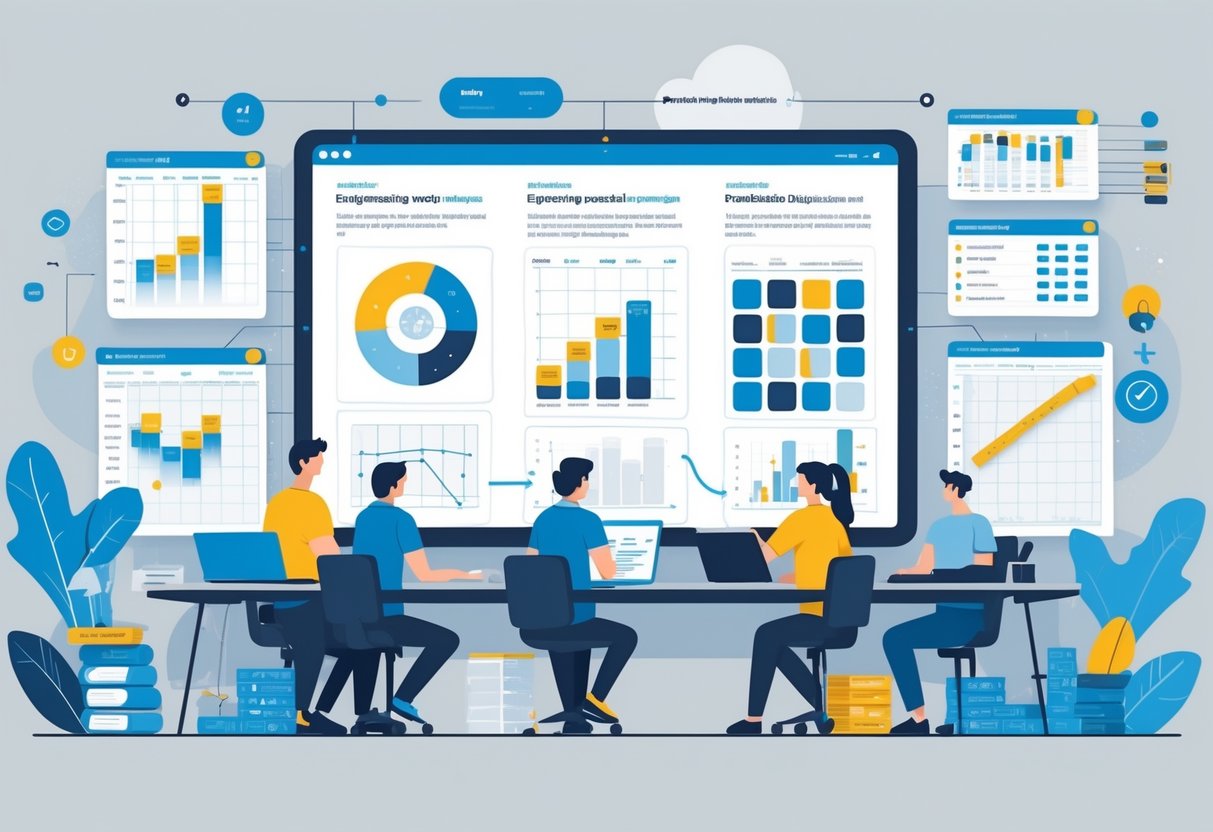
Scoring systems give engineering teams a numerical way to compare tasks and make data-driven decisions about what to build next. These models assign values to different criteria, then combine them into a single score that ranks work items objectively.
RICE Scoring Model
The RICE framework evaluates projects using four factors: Reach, Impact, Confidence, and Effort. Reach measures how many users or systems the change affects within a specific time period. Impact rates the degree of effect on each user, typically on a scale from 0.25 (minimal) to 3 (massive).
Confidence accounts for uncertainty in the estimates, expressed as a percentage from 0% to 100%. Effort captures the total person-months required from all team members. The formula divides the product of Reach, Impact, and Confidence by Effort: (Reach × Impact × Confidence) / Effort.
Engineering leaders use RICE scoring to prioritize organization-wide initiatives including platform investments and technical infrastructure work. A migration affecting 10,000 services with high impact (3), full confidence (100%), and 6 person-months of effort scores 5,000, while a small optimization touching 500 services with medium impact (1), moderate confidence (80%), and 1 person-month scores 400.
The rice model works best when teams have reliable usage data and can estimate effort accurately based on past projects.
ICE Scoring Model
The ICE scoring model simplifies prioritization by evaluating just three dimensions: Impact, Confidence, and Ease. Each factor receives a score from 1 to 10, and the final ICE score is their average or sum. Impact measures the potential benefit to users or business metrics.
Confidence reflects how certain the team feels about the expected outcomes and estimates. Ease represents how simple the implementation is, considering technical complexity and resource availability. Teams often use the ice model for rapid decision-making during sprint planning or when comparing a large backlog of features.
A security patch might score Impact 9, Confidence 10, and Ease 7 for an average of 8.7. A speculative performance optimization could score Impact 6, Confidence 4, and Ease 5 for an average of 5.0. The ice scoring model removes the complexity of the rice framework by dropping the Reach calculation, making it faster for teams that need quick prioritization without extensive data gathering.
Platform teams frequently apply this approach when evaluating developer experience improvements or technical debt items where usage metrics are harder to quantify.
Kano Model
The Kano model categorizes features into five types based on how they affect user satisfaction. Basic features are expected requirements that cause dissatisfaction when missing but don't increase satisfaction when present. Performance features create satisfaction proportional to their quality - better implementation means happier users.
Excitement features delight users when present but don't cause dissatisfaction when absent. Indifferent features have no meaningful impact on satisfaction either way. Reverse features actually decrease satisfaction for some user segments.
Engineers use the kano model to identify which investments deliver the highest satisfaction returns. An API that returns results in 100ms versus 500ms is a performance feature - faster is always better. Auto-complete suggestions in a command-line tool might be an excitement feature that differentiates the product.
Teams conduct Kano surveys by asking users two questions per feature: how they'd feel if it was present and how they'd feel if it was absent. The response patterns reveal which category each feature belongs to. This model helps engineering leaders avoid over-investing in basic features that users simply expect while identifying excitement features that create competitive advantages.
Optimizing Execution and Ongoing Prioritization

Effective execution requires identifying tasks with immediate payoff, embedding prioritization into sprint cycles, and maintaining adaptive review cadences that respond to shifting technical and business conditions.
Identifying Quick Wins
Quick wins deliver high business value with minimal engineering effort. These tasks often emerge from value-effort mapping exercises where teams plot potential impact against implementation cost.
Engineers should target low-effort, high-value opportunities that reduce friction in critical paths. Examples include one-line bug fixes blocking customer workflows, configuration changes that unlock dormant features, or API endpoint optimizations that improve response times by 40% without architectural changes.
Teams that systematically catalog quick wins maintain a backlog buffer for sprint planning. When blockers arise or velocity dips, these items keep momentum without derailing longer initiatives. The key is balancing immediate productivity gains against strategic roadmap commitments.
Top engineering organizations review quick win candidates weekly. They assess whether customer preferences have shifted the relative value of deferred items and whether new tooling has reduced previously high-effort tasks to trivial implementations.
Sprint Planning Integration
Sprint planning integration transforms prioritization from periodic exercise into continuous practice. Teams allocate capacity based on predefined priority levels, reserving percentages for P0 incidents, technical debt, and feature development.
Engineers assign stack-ranked items to sprints using clear acceptance criteria. Each task carries metadata on business value, dependencies, and risk factors. This structure prevents scope creep and ensures alignment between engineering capacity and product commitments.
Effective sprint planning incorporates capacity buffers for unplanned work. Teams typically reserve 20% of velocity for customer escalations and production issues. This buffer protects planned commitments while maintaining responsiveness to operational demands.
Continuous Review Processes
Prioritization is not static and requires regular adjustment as business conditions evolve. Engineering managers conduct weekly reviews of priority rankings, evaluating whether technical discoveries or market feedback warrant reordering the backlog.
Review cadences should align with release cycles. Teams shipping weekly reassess priorities every three to five days. Those on monthly cycles review bi-weekly. The goal is catching priority inversions before they waste engineering cycles on obsolete work.
Structured review processes examine three dimensions: business value drift, technical feasibility changes, and dependency updates. When customer preferences shift or new data reveals higher-impact opportunities, teams reprioritize without attachment to prior rankings.
Wake Up Your Tech Knowledge
Join 40,000 others and get Codeinated in 5 minutes. The free weekly email that wakes up your tech knowledge. Five minutes. Every week. No drowsiness. Five minutes. No drowsiness.