Staff Engineer vs Engineering Manager: Strategic Insights for CTOs
Choose between staff engineer and engineering manager roles. Understand the differences, trade-offs, and career implications of each path.
Posted by
 Joseph Kaplan
Related reading
Decision Making for Engineers: Gain Strategic Systems Insight Now
Develop decision-making frameworks for engineers. Learn how to evaluate trade-offs, manage uncertainty, and make high-impact technical decisions.
Engineering Leadership in Budget-Constrained Environments [Don't Miss These Key Tactics!]
Lead engineering teams with limited budgets. Learn strategies for maximizing impact, prioritizing investments, and delivering value with constraints.
Engineering Leadership: Systems-Level Strategies to Win in Tech
Master the essential skills and frameworks for engineering leadership. Learn how to balance technical depth with team development, make strategic decisions, and drive business impact.
Core Differences Between Staff Engineer and Engineering Manager
Staff engineers drive technical execution through deep expertise and architectural decisions, while engineering managers build organizational capacity through people leadership and process design. The distinction reshapes how technical decisions flow, how teams scale, and where accountability lives.
Primary Responsibilities
A staff engineer provides engineering support through design, development, and technical evaluation of complex systems. They own architectural decisions that affect multiple teams, resolve technical debt at the system level, and establish engineering standards that shape how code gets written across the organization.
Staff engineers spend their days in code reviews, design documents, and technical spikes. They prototype solutions to validate approaches before teams commit resources. They also mentor engineers on technical problems, breaking down complex implementations into manageable work streams.
Engineering managers oversee teams of engineers to ensure projects ship on time and within budget. They conduct one-on-ones, performance reviews, and hiring interviews. Engineering managers translate business requirements into technical roadmaps, allocate engineers across projects, and remove blockers that slow delivery.
The manager role requires tracking project timelines, budget constraints, and team capacity. They coordinate with product managers, other engineering leaders, and the CTO to align technical work with business goals. They also handle conflict resolution, career development conversations, and team morale.
Impact and Scope of Influence
Staff engineers create leverage through technical decisions that multiply team effectiveness. A single architectural choice - selecting a message queue, defining API contracts, or standardizing observability practices - affects how hundreds of engineers work for years. They reduce complexity by building internal frameworks that abstract common patterns, cutting development time from weeks to days.
Their influence spreads through design reviews, technical RFCs, and pairing sessions. Staff engineers set the technical direction without formal authority over people. They earn credibility by delivering results, making sound trade-offs, and explaining complex systems clearly.
Engineering managers need stronger project management skills because they oversee the entire engineering process from start to finish. They create leverage by growing people, building high-performing teams, and establishing processes that scale. A manager who improves hiring quality or reduces onboarding time from months to weeks directly impacts velocity.
Their scope includes team health metrics, delivery predictability, and engineer retention. They shape culture through the behaviors they reward and the standards they enforce.
Organizational Structure
Staff engineers typically report to engineering managers, directors, or the CTO depending on company size. They operate as individual contributors without direct reports, though they often lead technical initiatives involving multiple teams. Some organizations place staff engineers in a centralized architecture group, while others embed them within product teams.
Engineering managers work in office settings but spend significant time in meetings coordinating cross-functional work. They report to senior engineering managers, VPs of engineering, or the CTO. Managers build hierarchical structures with clear reporting lines, making them accountable for team output and people development.
The career ladder splits at senior levels. Engineers progress to staff, principal, and distinguished engineer roles through technical impact. Managers advance to senior manager, director, and VP through organizational scope. Both paths can lead to CTO roles, though the route shapes what type of CTO they become - one focused on technical strategy versus organizational scaling.
Key Skills: Technical and Managerial Competencies
Wake Up Your Tech Knowledge
Join 40,000 others and get Codeinated in 5 minutes. The free weekly email that wakes up your tech knowledge. Five minutes. Every week. No drowsiness. Five minutes. No drowsiness.
Staff engineers excel through deep technical expertise and architectural vision, while engineering managers focus on team coordination and resource allocation. Both roles demand strong communication abilities but apply them differently based on their core responsibilities.
Technical Leadership
Staff engineers drive technical direction across multiple teams without managing people directly. They design systems at scale and make architecture decisions that affect the entire engineering organization. These engineers evaluate trade-offs between different technical approaches by analyzing performance benchmarks, cost profiles, and long-term maintenance burden.
A staff engineer must possess expert-level knowledge in programming languages, system design, and infrastructure patterns. They select tool chains based on concrete metrics rather than trends. When integrating AI capabilities or building internal frameworks, they consider how each choice impacts deployment velocity and operational costs.
Engineering managers need sufficient technical depth to understand architecture proposals and challenge implementation plans. They maintain coding skills but spend less time writing production code. Their technical competence allows them to assess project feasibility and identify when teams face genuine technical blockers versus process issues.
Management and People Skills
Engineering managers handle hiring, feedback, performance reviews, and team prioritization as core duties. They support career development for each direct report and navigate interpersonal challenges that arise within teams. Project management becomes critical as managers coordinate efforts across multiple initiatives while tracking dependencies and timelines.
These leaders allocate resources efficiently by understanding each team member's strengths and growth areas. They protect their team's focus time from unnecessary meetings and interruptions. When personal emergencies affect team members, managers quickly redistribute work to maintain delivery commitments.
Staff engineers mentor developers through technical guidance rather than formal management relationships. They influence by demonstrating best practices and building consensus around technical standards. While they don't conduct performance reviews, their technical assessments carry significant weight in promotion decisions.
Communication Skills
Both roles require exceptional communication skills but apply them in distinct contexts. Staff engineers articulate complex technical concepts to non-technical stakeholders and write architecture documents that guide implementation across quarters. They present trade-off analyses to leadership using cost data and performance projections rather than abstract benefits.
Engineering managers communicate continuously with product teams, designers, and business stakeholders to align technical work with company objectives. They translate business requirements into technical priorities their teams can execute. During cross-functional planning, they represent engineering constraints and negotiate realistic timelines based on team capacity.
A tech lead or staff engineer runs technical design reviews and provides detailed code feedback to raise engineering standards. They document decision rationale so future teams understand why specific approaches were chosen. Engineering managers focus communication on project status, risk mitigation, and resource needs when reporting to senior leadership.
Career Progression and Advancement
Both paths offer distinct advancement opportunities that scale technical influence differently. Staff engineers deepen architectural impact across systems, while engineering managers expand organizational reach through team development and cross-functional alignment.
Pathways From Senior Engineer
A senior engineer reaches the decision point when they become the primary knowledge holder on critical systems or when colleagues seek their input on technical and career decisions. The fork typically presents itself when all senior mentors have left the team, creating a leadership vacuum.
The staff engineer path prioritizes technical depth. Engineers on this track focus on system design, architectural decisions, and technical mentorship without managing people directly. They influence through code reviews, design documents, and technical roadmaps.
The engineering manager path shifts focus to people development and team outcomes. This transition requires different skills than coding excellence. Managers handle performance reviews, career development conversations, and resource allocation across multiple projects.
Both paths require demonstrated leadership before the formal title arrives. Senior engineers who consistently unblock teammates, drive technical decisions, and maintain system knowledge position themselves for either direction.
Transition to Leadership Roles
Staff engineers lead through technical authority. They design systems that scale across multiple teams and guide architecture decisions that affect the entire engineering organization. Their influence grows as they solve increasingly complex technical problems and mentor other engineers on best practices.
Engineering managers stop writing production code to focus on team effectiveness. They hire engineers, remove obstacles, and translate business requirements into technical work. The role demands enough technical knowledge to make informed decisions without being the primary implementer.
The transition requires deliberate skill development. Future managers practice delegation, conflict resolution, and project planning before taking the role. Aspiring staff engineers build expertise in system design, technical writing, and cross-team collaboration.
Engineers can switch between paths, but each transition requires rebuilding credibility in a different domain.
Long-Term Growth Opportunities
Staff engineers advance to principal and distinguished engineer roles, overseeing technical strategy for hundreds of engineers. Their scope expands from single systems to entire technical platforms. They evaluate tool-chain selection, AI integration strategies, and engineering process improvements that shift cost profiles and delivery speed.
Engineering managers can eventually influence thousands of people by moving into director and VP positions. They shape engineering culture, set organizational priorities, and align technical investments with business objectives. Their decisions affect hiring strategies, team structures, and budget allocation.
Both paths offer executive-level opportunities. Staff engineers can become CTOs through technical leadership, while managers reach the same position through organizational leadership. The distinction matters less at senior levels where technical strategy and people strategy converge.
Top engineering leaders combine deep technical judgment with team-building capabilities, regardless of their path. They understand how architecture choices affect team velocity and how organizational design impacts system quality.
Day-to-Day Work and Decision-Making Authority

Staff engineers spend most of their time on technical architecture and design work, while engineering managers focus on team coordination and delivery timelines. The choice between these paths determines whether someone leads through code and system design or through people and processes.
Wake Up Your Tech Knowledge
Join 40,000 others and get Codeinated in 5 minutes. The free weekly email that wakes up your tech knowledge. Five minutes. Every week. No drowsiness. Five minutes. No drowsiness.
Coding Versus Meetings
Staff engineers write code daily, though less than junior developers. They typically spend 40-60% of their time coding, with the rest dedicated to architecture reviews, technical design documents, and mentoring other engineers through code reviews. Their calendar includes targeted technical discussions about system design trade-offs, API contracts, and performance optimization strategies.
Engineering managers attend more meetings throughout the week. They run sprint planning sessions, one-on-ones with direct reports, stakeholder updates, and cross-team coordination discussions. Most engineering managers spend 60-80% of their day in meetings or handling people-related tasks like performance reviews, hiring interviews, and conflict resolution. Some engineering managers maintain a small amount of coding work, but it becomes secondary to their management responsibilities.
The meeting types differ significantly between roles. Staff engineers join technical deep-dives where they evaluate database sharding strategies or service mesh implementations. Engineering managers focus on resource allocation, deadline negotiations, and removing blockers that prevent their teams from shipping features.
Role in Technical Decisions
Staff engineers own the technical direction for major systems or entire product areas. They make binding decisions about technology choices, architecture patterns, and engineering standards. When a team debates between microservices and a monolith, the staff engineer evaluates the trade-offs based on scale requirements, team size, and operational complexity, then documents the decision in a design document that guides implementation.
Technical leadership without direct reports means staff engineers influence through expertise rather than organizational authority. They set technical standards by writing reference implementations, creating internal frameworks, and establishing code review practices that other engineers follow. Their decisions shape how teams build software, which libraries enter the approved stack, and how services communicate across boundaries.
Engineering managers participate in technical decisions but defer to staff engineers on deep architectural questions. They ensure technical decisions align with delivery timelines and team capacity. An engineering manager might challenge a staff engineer's proposal if it requires skills the team lacks or extends the project timeline beyond business constraints.
Authority Over Project Management
Engineering managers control project timelines, resource allocation, and sprint commitments. They decide which features get built first, how many engineers work on each project, and when to ship or delay releases. When product managers request new features, engineering managers evaluate team capacity and negotiate realistic delivery dates.
Staff engineers influence project management through technical feasibility assessments. They identify technical dependencies that affect timelines, estimate the complexity of proposed features, and flag architectural work that needs to happen before new features can launch. A staff engineer might tell an engineering manager that a requested feature requires three weeks of database migration work before any feature development can begin.
The collaboration works best when engineering managers handle the "when and who" while staff engineers handle the "how and why." Engineering managers track velocity metrics, manage team burnout, and adjust sprint capacity based on holidays or oncall rotations. Staff engineers ensure the team builds systems that scale, maintains code quality standards, and avoids technical debt that slows future development.
Architectural Responsibilities and System Design

Staff engineers own the technical blueprint that shapes how systems scale and integrate, while engineering managers build the team structures that execute those plans. Both roles shape architecture, but through different lenses of influence and accountability.
Ownership of Architecture
A staff engineer designs and maintains technical architecture across multiple systems and services. They make critical decisions about data flow, service boundaries, and technology stack choices that affect the entire organization. These decisions include selecting databases, defining API contracts, and establishing patterns for error handling and observability.
Staff engineers evaluate trade-offs between build-versus-buy decisions based on team capability, maintenance burden, and long-term cost profiles. They document architecture decision records that capture the reasoning behind technical choices. When systems need to handle 10x traffic growth, they design the caching layers, database sharding strategies, and queue architectures that make scaling possible.
The staff engineer also establishes technical standards for code quality, testing approaches, and deployment practices. They review pull requests for architectural compliance and mentor other engineers on design patterns. When technical debt accumulates, they prioritize refactoring efforts based on business impact and engineering velocity metrics.
Cross-Team Technical Influence
Staff engineers drive technical alignment across engineering teams without formal authority over people or projects. They facilitate architecture review meetings where teams present designs and receive feedback on integration points, security considerations, and performance implications. This influence requires building credibility through consistently sound technical judgment and deep system knowledge.
A staff engineer identifies patterns across teams and promotes shared libraries, common infrastructure, and reusable components. When three teams independently build similar authentication systems, the staff engineer recognizes the duplication and proposes a unified approach. They work with tech leads to migrate existing implementations and establish the new pattern as the organizational standard.
They also break down large technical initiatives into phases that multiple teams can execute in parallel. For a microservices migration, the staff engineer defines service boundaries, API specifications, and data migration strategies that allow teams to work independently while maintaining system coherence. They track dependencies, identify blockers, and adjust the technical roadmap based on team capacity and business priorities.
Influence on Hiring, Team Dynamics, and Culture

Staff engineers shape team culture through technical standards and architectural decisions, while engineering managers directly build teams through hiring authority and performance management. Both roles affect who joins the team and how engineers grow, but through different mechanisms.
Involvement in Hiring Processes
Engineering managers own the complete hiring pipeline. They write job descriptions, screen resumes, conduct interviews, and make final hiring decisions. They manage headcount budgets and determine team composition based on project needs and skill gaps.
Staff engineers participate in hiring but lack direct authority. They design technical interviews, evaluate candidates' coding abilities, and assess architectural thinking. Their input carries significant weight during hiring decisions, especially for senior technical roles. A staff engineer might reject a candidate based on technical concerns, but the engineering manager makes the final call on team composition.
Tech leads often bridge these responsibilities. They work closely with engineering managers to define role requirements and identify the technical skills needed for upcoming projects. The hiring process works best when staff engineers and managers collaborate - engineers validate technical depth while managers assess team fit and communication skills.
Mentorship and Team Development
Engineering managers handle all formal development activities. They conduct one-on-ones, write performance reviews, set career goals, and create growth plans. They're responsible for motivating and leading teams of engineers, which requires strong interpersonal skills and the ability to give direct feedback on both technical and behavioral issues.
Staff engineers mentor through technical guidance and example. They review code, explain architectural patterns, and help engineers solve complex problems. They demonstrate best practices in system design and code quality. This mentorship happens informally during daily work rather than in structured performance discussions.
Both roles shape engineering culture differently. Managers set team norms around meeting cadence, communication expectations, and work-life balance. Staff engineers establish technical culture through their choice of tools, testing standards, and code review practices.
Choosing the Right Path: Strategic Considerations for Engineers
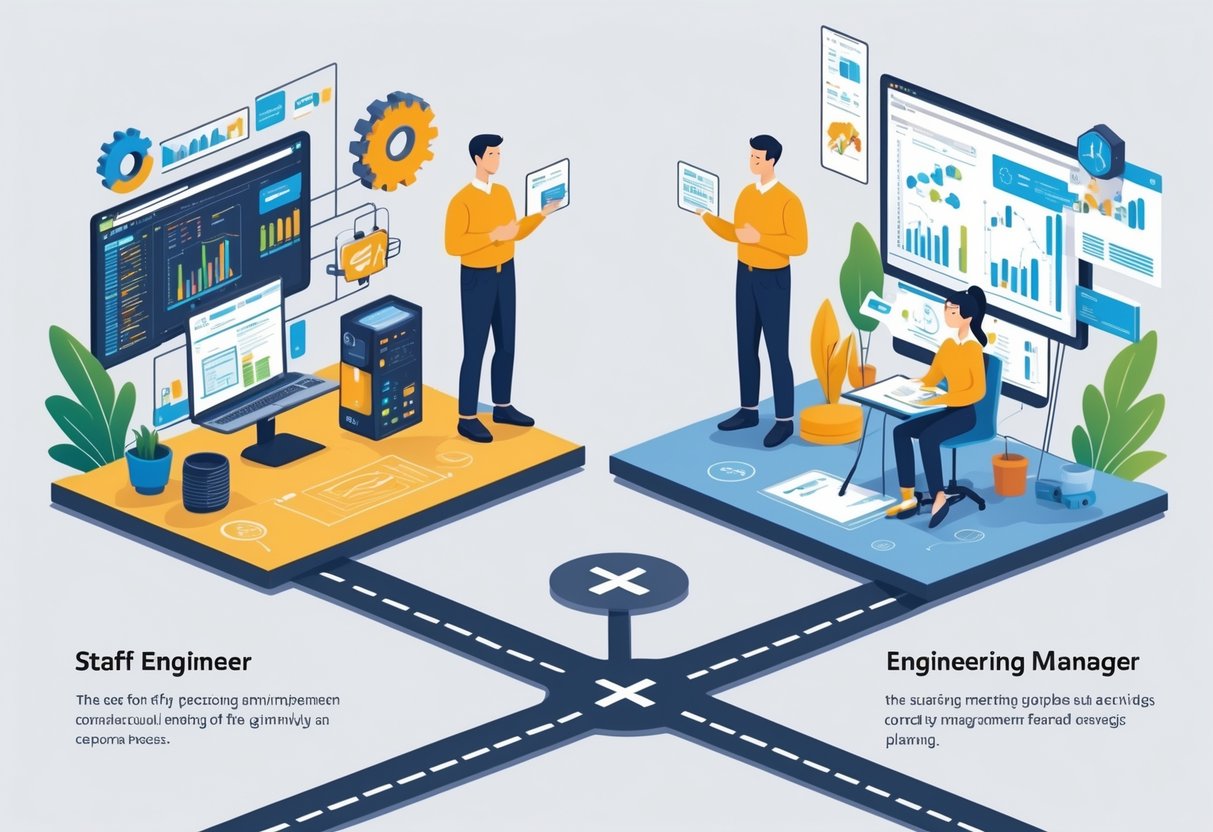
The decision between staff engineer and engineering manager requires evaluating technical strengths against organizational gaps and understanding how each role compounds value differently across teams.
Assessing Personal Strengths
Engineers must evaluate whether they derive energy from deep technical problem-solving or from enabling others to succeed. A staff engineer thrives when designing systems that handle scale, refactoring legacy architectures, or establishing technical standards across multiple teams. They need strong pattern recognition, the ability to navigate ambiguous requirements, and comfort operating without direct authority.
An engineering manager succeeds by improving team output through coaching, removing blockers, and aligning work with business priorities. They handle one-on-ones, performance reviews, and cross-functional coordination with product and design. The role demands emotional intelligence and the ability to context-switch rapidly between technical decisions and people issues.
Key indicators for the staff track:
- Energized by architecture reviews and technical design docs
- Prefer solving complex problems over managing schedules
- Comfortable influencing without formal authority
Key indicators for the management track:
- Motivated by team growth and career development
- Enjoy facilitating collaboration across disciplines
- Find satisfaction in clearing obstacles for others
Aligning With Business Needs
Organizations signal which path they value through promotion criteria and resource allocation. A company scaling rapidly often needs engineering managers who can build high-performing teams and hire effectively. A product-focused company with technical debt may prioritize staff engineers who can modernize infrastructure while maintaining velocity.
Engineers should examine where leadership gaps exist. If senior developers lack mentorship or architectural guidance suffers from inconsistent patterns, the staff role addresses critical needs. If teams miss deadlines due to unclear priorities or poor collaboration, management skills become essential.
The CTO's technical strategy reveals organizational priorities. Companies investing in platform consolidation, AI integration, or developer productivity tooling need staff engineers who can evaluate trade-offs between build versus buy decisions. Those expanding into new markets or scaling teams across geographies need managers who understand recruiting, onboarding, and distributed team dynamics.
Real-World Outcomes in High-Performing Teams
Staff engineers at top organizations drive measurable improvements in system reliability, deployment frequency, and technical debt reduction. They establish patterns that prevent recurring issues - standardizing observability practices, implementing automated testing frameworks, or designing APIs that reduce cross-team dependencies.
Engineering managers impact team retention, delivery predictability, and cross-functional satisfaction scores. They create processes that reduce context-switching costs, protect focus time for engineers, and ensure technical work aligns with product roadmaps. The best managers maintain enough technical depth to participate in architecture discussions while delegating implementation to their teams.
Both roles require different leverage models. A staff engineer's technical decisions might affect dozens of services and multiple teams. An engineering manager's coaching might unlock performance improvements across five to eight direct reports. Neither path guarantees faster promotion to CTO - both require demonstrating business impact at increasing scope.
Engineers who study how technical leaders make tool-chain selections, evaluate AI integration strategies, and design engineering processes gain clearer insight into which path matches their strengths. Understanding these decision models helps rising leaders position themselves for roles that compound their natural advantages.
Wake Up Your Tech Knowledge
Join 40,000 others and get Codeinated in 5 minutes. The free weekly email that wakes up your tech knowledge. Five minutes. Every week. No drowsiness. Five minutes. No drowsiness.