Systems Thinking for Engineers: A Strategic Advantage for CTOs
Master systems thinking for engineering. Learn how to think holistically about complex systems and make better decisions.
Posted by
 Joseph Kaplan
Related reading
CTO Architecture Ownership at Early-Stage Startups: Execution Models & Leadership Clarity
At this stage, architecture is about speed and flexibility, not long-term perfection - sometimes you take on technical debt, on purpose, to move faster.
CTO Architecture Ownership at Series A Companies: Real Stage-Specific Accountability
Success: engineering scales without CTO bottlenecks, and technical strategy is clear to investors.
CTO Architecture Ownership at Series B Companies: Leadership & Equity Realities
The CTO role now means balancing technical leadership with business architecture - turning company goals into real technical plans that meet both product needs and investor deadlines.
Core Principles of Systems Thinking in Engineering
Engineers who apply systems thinking recognize that components behave differently in isolation than they do within larger assemblies, and that relationships between elements often matter more than the elements themselves. Systems thinking principles guide engineers to evaluate how feedback loops, delays, and dependencies shape system behavior across time scales.
Holistic Problem Framing
Engineers bound problems by defining what sits inside versus outside the system of interest. This boundary determines which variables they control, which they influence, and which remain external constraints.
A payment processing team that frames their problem narrowly might optimize transaction speed. A team using holistic framing evaluates how that speed affects database load, error handling, customer support volume, and fraud detection accuracy.
Engineering teams analyze how components interact rather than optimizing parts in isolation. They map dependencies across services, infrastructure, and human processes before committing to solutions.
Key boundary decisions include:
- Which downstream systems must handle outputs
- What upstream failures propagate into the design
- Which regulatory or compliance frameworks constrain choices
- How maintenance and support infrastructure connects
Engineers who frame problems holistically identify cost drivers that narrow optimization misses. They structure designs that account for operational reality rather than idealized use cases.
Interconnectedness and Interdependence
Systems thinking examines how changes in one component ripple through connected elements. Engineers trace these pathways to predict where modifications create unintended consequences.
When a team changes API rate limits, they affect cache hit rates, database connection pools, error recovery logic, and monitoring alert thresholds. Each of these interdependencies can trigger cascading effects.
Engineers map these connections using architecture diagrams, dependency graphs, and data flow models. They identify tight coupling where changes propagate quickly and loose coupling where buffers absorb variation.
Critical interdependencies include:
- Data contracts between services
- Shared infrastructure resources
- Authentication and authorization chains
- Deployment and rollback procedures
High-performing engineering organizations document these relationships explicitly. They run failure mode analysis to understand how component degradation affects system-wide behavior before incidents occur.
Emergence and Nonlinear Dynamics
Emergence describes behaviors that arise from component interactions rather than from individual parts. Complex systems produce patterns that engineers cannot predict by analyzing isolated elements.
A distributed cache appears straightforward until traffic patterns create hot spots that cascade into database overload. The failure mode emerges from the relationship between request distribution, cache eviction policies, and connection pool sizing.
Engineers encounter nonlinear dynamics when small input changes produce disproportionate outputs. Doubling traffic might quadruple latency if the system crosses a threshold where queuing theory dominates performance.
Common emergence patterns include:
- Thundering herd effects during cache invalidation
- Deadlocks from circular resource dependencies
- Performance cliffs at specific load levels
- Feedback loops between monitoring and system behavior
Systems thinking concepts help engineers anticipate these behaviors through modeling and simulation. They design systems with observability that reveals emergent patterns before they cause production incidents.
Essential Systems Thinking Concepts for Engineers
Wake Up Your Tech Knowledge
Join 40,000 others and get Codeinated in 5 minutes. The free weekly email that wakes up your tech knowledge. Five minutes. Every week. No drowsiness. Five minutes. No drowsiness.
Engineers who master feedback loops and causality can predict how their technical decisions ripple through production systems, while those who build accurate mental models avoid costly rework cycles. Understanding system boundaries prevents scope creep and ensures teams optimize for the right performance metrics.
Feedback Loops and Causality
Feedback loops determine whether a system stabilizes or spirals out of control. A balancing loop works like a thermostat, correcting deviations from a target state - when CPU usage spikes, auto-scaling adds instances until load normalizes. A reinforcing loop amplifies changes in one direction, such as technical debt that slows development velocity, which then delays refactoring, which compounds more debt.
Engineers must trace causality chains to identify leverage points. When API response times degrade, the root cause might be three steps removed: increased user adoption drove query complexity, which exposed an unindexed database column, which triggered full table scans. High-performing teams document these causal relationships during post-mortems and build monitoring that tracks leading indicators, not just symptoms.
Understanding causality helps engineering leaders decide where to intervene. Adding cache layers treats symptoms, while redesigning the data model addresses root causes. The choice depends on time constraints, technical debt tolerance, and roadmap priorities - trade-offs that Codeinate explores through real decision frameworks from engineering leaders managing similar constraints.
Mental Models
Mental models are the assumptions engineers hold about how systems behave. An engineer might assume microservices always improve scalability, but this model breaks down when network latency between services exceeds monolithic function call overhead. Inaccurate mental models lead to architecture decisions that fail under production load.
The iceberg model reveals how visible events sit atop hidden patterns, underlying structures, and mental models. When deployment failures spike, the event is obvious. The pattern might be Friday afternoon releases. The structure could be inadequate staging environments. The mental model might be "speed matters more than safety."
Engineers refine mental models through experimentation and measurement. Load testing validates assumptions about system capacity. A/B testing reveals whether architectural changes actually improve user experience. Teams that challenge their mental models with data avoid confirmation bias and adapt faster to changing requirements.
Boundaries and System Mapping
System boundaries define what engineers optimize and what they treat as external constraints. Drawing boundaries too narrowly leads to local optimizations that harm the broader system - caching aggressively in one service might starve shared resources needed by others. Drawing boundaries too broadly creates analysis paralysis.
System mapping visualizes components, dependencies, and information flows. A service dependency graph shows which APIs call which databases, revealing critical paths and single points of failure. Data flow diagrams expose where information gets transformed, stored, or duplicated - often highlighting opportunities to eliminate redundant processing.
Elite engineering teams map systems at multiple scales. They create high-level architecture diagrams for strategic planning, detailed sequence diagrams for debugging, and dependency matrices for impact analysis before changes. These maps become shared artifacts that align cross-functional teams and prevent siloed decision-making that ignores downstream consequences.
Systems Engineering and Its Synergy With Systems Thinking
Systems engineering provides the structured framework that transforms systems thinking principles into tangible products and reliable operations. The discipline integrates customer requirements with technical execution across multi-disciplinary teams while managing complexity through proven development processes.
Structured Development Processes
Systems engineers follow a deliberate progression from concept through production that embeds feedback loops and validation at each stage. The process begins with defining customer needs and documenting requirements before moving into design synthesis. This structured approach prevents the costly rework that occurs when teams skip directly to implementation.
Key Process Stages:
- Requirements definition - Captures functional needs and constraints
- Design synthesis - Translates requirements into architectural decisions
- Validation - Verifies the system meets specifications under real conditions
- Production - Scales the design for manufacturing and deployment
Applying systems thinking to systems engineering creates superior outcomes by examining how components interact rather than optimizing parts in isolation. Engineers who map feedback loops during the design phase catch destructive resonance patterns before they reach production. The Tacoma Narrows Bridge collapse demonstrated how ignoring wind-induced feedback between the deck and environment led to catastrophic failure despite meeting static load requirements.
Integration With Multi-Disciplinary Teams
Systems engineering coordinates specialists across mechanical, electrical, software, and operations domains into a unified development effort. Each discipline contributes domain expertise while systems engineers maintain the holistic view that prevents subsystem conflicts.
Effective teams establish shared models that surface integration risks early. When mechanical engineers select materials without consulting thermal specialists, component thermal expansion can misalign precision assemblies during operation. Systems engineers facilitate these cross-functional reviews through structured interface definitions and integration testing protocols.
The discipline also addresses non-technical factors that technical teams often overlook. A well-designed system fails in the field without maintenance infrastructure, trained operators, and spare parts logistics. High-performing engineering organizations recognize that technical solutions require support systems spanning training, documentation, and supply chains to deliver lasting value.
Analytical Tools for Systems-Thinking Engineers

Engineers use specialized visual tools to map system behavior and identify leverage points where small interventions create significant change. These diagrams expose feedback loops and accumulation patterns that traditional process maps miss.
Wake Up Your Tech Knowledge
Join 40,000 others and get Codeinated in 5 minutes. The free weekly email that wakes up your tech knowledge. Five minutes. Every week. No drowsiness. Five minutes. No drowsiness.
Causal Loop Diagrams
Causal loop diagrams reveal how variables influence each other through reinforcing and balancing feedback loops. Engineers draw these diagrams collaboratively because no single person understands every connection in complex systems.
Each arrow shows causality with a plus or minus sign. A plus means both variables move in the same direction. A minus means they move in opposite directions.
Common archetypes appear repeatedly across different systems. The "limits to growth" archetype shows how a reinforcing loop drives initial success until a balancing loop kicks in and constrains further progress. Engineering teams see this when scaling infrastructure - performance improves rapidly until bottlenecks emerge in database connections or API rate limits.
The "shifting the burden" archetype reveals dangerous patterns where quick fixes mask root causes. Teams applying band-aid solutions to production incidents create reinforcing loops that prevent systematic improvements. High-performing engineering organizations use causal loop diagrams during post-mortems to distinguish symptoms from systemic issues, then invest in architectural changes that eliminate entire classes of problems rather than patching individual failures.
Stock and Flow Diagrams
Stock and flow diagrams quantify accumulation over time and the rates that change those accumulations. Stocks represent quantities that build up or drain - technical debt, queue depth, or knowledge within a team. Flows represent rates of change like story points completed per sprint or bugs introduced per deployment.
Engineers use rectangular boxes for stocks and valve symbols for flows. Arrows connect them to show dependencies.
These diagrams help teams model capacity planning scenarios. A stock of unresolved customer issues accumulates based on the inflow of new tickets minus the outflow of resolved cases. When the resolution rate drops below the arrival rate, the backlog grows exponentially. Engineering leaders simulate different hiring timelines, automation investments, and process changes to find combinations that keep stocks within acceptable bounds while optimizing cost and delivery speed.
Decision-Making and Management Through a Systems Lens

Engineers face choices that ripple across timelines, budgets, and technical dependencies. Systems thinking transforms decision-making by mapping how choices affect interconnected components and revealing where small changes create outsized impact.
Scenario Analysis and Leverage Points
Systems thinking helps engineers design smarter solutions by modeling multiple futures before committing resources. Engineers build scenario trees that trace how architecture decisions propagate through integration points, testing frameworks, and deployment pipelines. A database schema choice affects query performance, caching strategy, API response times, and monitoring complexity.
Leverage points are intervention sites where modest effort produces disproportionate results. Top teams identify these by mapping feedback loops and bottlenecks. Standardizing API contracts early prevents integration sprawl later. Automating validation checks at merge time catches defects before they compound across sprints.
Engineering managers use decision making through systems thinking to evaluate trade-offs between build velocity and technical debt. They assess whether adopting a new framework accelerates feature delivery or fragments the toolchain. They model staffing scenarios to understand how adding specialists affects knowledge transfer and bus factor risk.
Key leverage points in engineering systems:
- Architectural boundaries that isolate change
- Automated verification gates that prevent regression
- Shared abstractions that reduce cognitive load
- Observability standards that surface failures fast
Risk Management and Unintended Consequences
Systems thinking anticipates how interventions create unexpected outcomes across connected subsystems. Engineers validate assumptions by asking what breaks when traffic doubles, when a dependency fails, or when a team member leaves. Systems thinking also anticipates longer-term consequences of potential actions rather than optimizing for immediate gains.
Verification processes catch direct failures. Validation reveals whether the system solves the right problem under real conditions. An API might pass all unit tests but create cascading timeouts when third-party services degrade. A deployment strategy might work in staging but overwhelm monitoring systems in production.
Engineering leaders build safeguards by red-teaming decisions. They ask how a caching layer affects consistency guarantees, how feature flags alter testing complexity, and how microservice boundaries shift operational burden. They track leading indicators - deployment frequency, rollback rates, incident response times - to detect accumulating risk before it manifests as outages.
Common unintended consequences:
- Performance optimizations that obscure debugging
- Abstraction layers that hide critical failures
- Monitoring dashboards that create alert fatigue
- Process improvements that slow decision velocity
Practical Applications and Real-World Case Studies
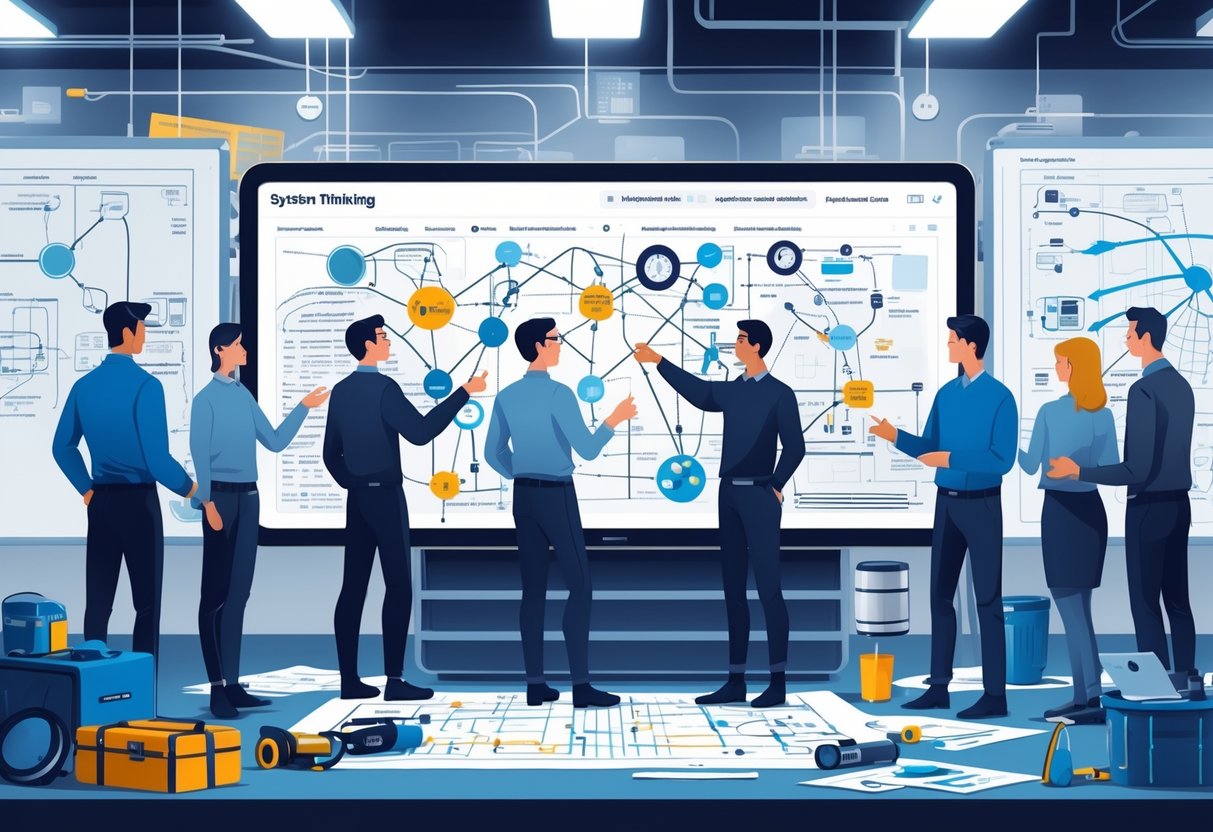
Engineers apply systems thinking to manage production lifecycles and drive sustainable innovation by analyzing feedback loops, component interactions, and long-term system behavior across complex systems.
Lifecycle Planning in Engineering Projects
Engineers who adopt systems thinking during lifecycle planning identify hidden dependencies before they become critical failures. This approach examines how components interact across design, production, support, and disposal phases rather than treating each stage separately.
Analysis of major engineering failures shows that inadequate lifecycle planning stems from bounded thinking. The Kursk submarine disaster occurred because engineers knew hydrogen peroxide reacted violently with copper catalysts, yet failed to plan for component degradation over the weapon's service life. The Stow Center School aquarium failed not from technical flaws but because no one planned for ongoing maintenance, spare parts procurement, or staff training.
Critical lifecycle planning elements:
- Maintenance infrastructure before deployment
- Supply chain resilience for replacement components
- Knowledge transfer systems for operational staff
- Degradation patterns under real-world conditions
Production systems require explicit planning for support structures. The Water of Ayolé project in Togo initially failed because engineers installed wells without establishing repair expertise, parts availability, or funding mechanisms. Success came only after local teams built a complete support ecosystem - training villagers in maintenance, connecting to hardware suppliers, and creating revenue streams through agricultural sales.
Supporting Innovation and Sustainability
Systems thinking enables engineers to design for sustainability by modeling how innovations affect broader technical and business systems over extended timeframes. This requires examining second-order effects that conventional analysis misses.
Complex systems exhibit emergent behaviors that only surface through holistic analysis. The Millennium Bridge in London underwent thorough wind tunnel testing and structural modeling, yet engineers missed synchronous lateral excitation because their models isolated components. Pedestrians naturally synchronized their steps with lateral sway, creating a reinforcing feedback loop. The oversight cost $7 million to retrofit dampers - expenses that proper systems analysis would have prevented.
Innovation evaluation framework:
| Factor | Systems Thinking Approach |
|---|---|
| Component interaction | Model feedback loops between subsystems |
| Environmental coupling | Test all operational conditions, not just nominal |
| Support requirements | Plan maintenance and knowledge transfer upfront |
| Economic viability | Include lifecycle costs in ROI calculations |
Engineers building sustainable solutions must account for socioeconomic factors alongside technical specifications. Pure technical solutions fail when they ignore human behavior, economic constraints, or organizational capacity. The Tacoma Narrows Bridge collapse resulted from choosing cheaper girders over trusses - a decision that saved $3 million but ignored known aerodynamic instability patterns. Top engineering teams now use structured systems thinking approaches to evaluate how design choices propagate through production, operation, and end-of-life stages before committing to architectures.
Adopting a Systems Mindset in High-Performing Teams

High-performing engineering teams build shared understanding of how components interact and create feedback loops for continuous learning. These practices turn abstract systems thinking into daily engineering work.
Building Shared Mental Models
Engineers often solve problems in isolation, optimizing individual components without understanding downstream effects. Systemic thinking requires team awareness of how changes ripple through internal and external systems.
Shared mental models start with explicit mapping sessions. Teams gather to diagram data flows, service dependencies, and failure modes on whiteboards or tools like Miro. They identify boundaries, feedback loops, and points where one team's optimization creates bottlenecks elsewhere.
Key practices include:
- Architecture decision records that document trade-offs and system-wide impacts
- Cross-functional design reviews where operations, security, and product teams surface constraints early
- Incident retrospectives that trace root causes through multiple system layers
Systems engineers facilitate these sessions by asking how each technical choice affects latency, cost, and maintainability across the entire stack. When teams align on a common view of the system, they catch problems before deployment and make faster decisions during incidents.
Continuous Synthesis and Learning
Engineering teams accumulate data from logs, metrics, and user feedback. Continuous synthesis transforms this information into actionable understanding of system behavior.
Effective synthesis practices:
| Practice | Impact |
|---|---|
| Weekly system health reviews | Teams spot patterns in error rates, resource usage, and latency before they become incidents |
| Post-deployment analysis | Engineers compare predicted vs. actual behavior to refine mental models |
| Load testing with chaos engineering | Teams discover emergent behaviors and feedback loops under stress |
Teams that excel at synthesis create tight feedback loops. They test hypotheses about system behavior, measure results, and update their models. By adopting a systems thinking mindset, teams enhance collaboration and improve decision-making processes.
This cycle prevents repeated mistakes. When a database slowdown cascades through microservices, teams document the causal chain and add monitoring at critical points. The next engineer benefits from that synthesis without repeating the investigation.
Wake Up Your Tech Knowledge
Join 40,000 others and get Codeinated in 5 minutes. The free weekly email that wakes up your tech knowledge. Five minutes. Every week. No drowsiness. Five minutes. No drowsiness.