Tech Leader Mental Models: Gain Strategic Clarity & Outperform AI Shifts
Develop mental models for tech leadership. Learn frameworks for thinking about systems, teams, and strategic decisions.
Posted by
 Joseph Kaplan
Related reading
Decision Making for Engineers: Gain Strategic Systems Insight Now
Develop decision-making frameworks for engineers. Learn how to evaluate trade-offs, manage uncertainty, and make high-impact technical decisions.
Engineering Leadership in Budget-Constrained Environments [Don't Miss These Key Tactics!]
Lead engineering teams with limited budgets. Learn strategies for maximizing impact, prioritizing investments, and delivering value with constraints.
Engineering Leadership: Systems-Level Strategies to Win in Tech
Master the essential skills and frameworks for engineering leadership. Learn how to balance technical depth with team development, make strategic decisions, and drive business impact.
Core Mental Models for Tech Leadership
Tech leaders who master foundational mental models make faster, more accurate decisions under pressure. These frameworks cut through complexity by exposing hidden assumptions, revealing downstream consequences, and separating what's observable from what's interpreted.
First Principles Thinking
First principles thinking strips problems down to their fundamental truths and rebuilds solutions from the ground up. Instead of reasoning by analogy or copying what competitors do, leaders identify the core constraints and ask what's actually possible given physics, economics, and engineering reality.
Elon Musk uses this approach to challenge industry assumptions. When SpaceX evaluated rocket costs, the team didn't accept existing prices. They broke down raw material costs for aluminum, titanium, carbon fiber, and fuel, then asked what it would take to manufacture in-house. The result cut launch costs by 90% compared to traditional aerospace contractors.
In software architecture, first principles thinking means questioning whether microservices, serverless, or monoliths fit the actual workload. A leader might discover that a simple PostgreSQL database handles the traffic profile better than a complex distributed system. The model forces technical decisions based on measurable requirements, not trends.
Top engineering teams apply this when evaluating build-versus-buy decisions. They calculate total cost of ownership across engineering time, maintenance burden, vendor lock-in risk, and feature velocity. The analysis often reveals that custom tooling costs less than SaaS products once team size crosses specific thresholds.
Inversion for Risk Analysis
Inversion flips decision-making by asking what causes failure instead of what drives success. Tech leaders identify catastrophic outcomes, then engineer systems to prevent them. This mental model surfaces blind spots that forward-looking planning misses.
A security architecture review using inversion asks: "How would an attacker breach this system?" Teams map attack vectors, privilege escalation paths, and data exfiltration routes. The exercise exposes gaps in authentication layers, API rate limiting, and encryption at rest.
For infrastructure decisions, inversion reveals single points of failure. Leaders ask what breaks when a region goes down, a database fails, or a key engineer leaves. The answers drive redundancy investments, disaster recovery automation, and knowledge documentation practices.
Platform teams apply this to API design. Instead of listing features they want to ship, they catalog failure modes: breaking changes that strand clients, rate limits that kill integrations, and authentication flows that leak credentials. The resulting API contracts include versioning strategies, detailed error codes, and backward compatibility guarantees.
The Map Is Not the Territory
Mental models represent reality but aren't reality itself. Documentation, roadmaps, and architecture diagrams are simplified representations. Tech leaders who confuse the map for the territory make decisions based on outdated or incomplete information.
A system architecture diagram shows clean service boundaries and well-defined APIs. The actual codebase contains undocumented dependencies, shared state, and workarounds that violate design principles. Leaders who trust the diagram without validating the implementation deploy changes that cascade into outages.
Sprint velocity charts suggest predictable delivery timelines. The numbers hide context: technical debt, team churn, and scope creep. A leader who treats velocity as fixed miscalculates project risk and overpromises to stakeholders.
The model pushes leaders to validate assumptions through direct observation. That means reviewing production logs, reading actual code, and talking to engineers doing the work. High-performing CTOs schedule regular deep dives into critical systems to reconcile mental models with ground truth.
Second-Order Thinking
Second-order thinking examines the consequences of consequences. Tech leaders look beyond immediate outcomes to understand how decisions ripple through systems, teams, and markets over time. This separates reactive management from strategic leadership.
A company adopts Kubernetes to gain container orchestration benefits. The first-order effect is improved deployment flexibility. The second-order effect is increased operational complexity, requiring dedicated platform engineers, new monitoring tools, and extended onboarding time. The third-order effect is opportunity cost as the team maintains infrastructure instead of shipping features.
AI integration decisions illustrate this clearly. Adding LLM-powered features delivers immediate user value. Second-order effects include API cost exposure, latency variability, and hallucination risks. Third-order effects involve customer trust erosion if outputs prove unreliable, plus regulatory compliance challenges as AI governance frameworks mature.
Leaders practicing second-order thinking map decision trees with probabilistic outcomes. They estimate how architectural choices affect hiring needs, how tooling decisions impact vendor leverage, and how open-source contributions influence talent attraction. Codeinate examines these trade-offs weekly, breaking down how technical leaders at high-growth companies evaluate long-term impacts before committing to platform shifts.
Decision-Making Frameworks Used by High-Performing Teams
Wake Up Your Tech Knowledge
Join 40,000 others and get Codeinated in 5 minutes. The free weekly email that wakes up your tech knowledge. Five minutes. Every week. No drowsiness. Five minutes. No drowsiness.
High-performing teams rely on specific mental models to cut through complexity and maintain velocity. They apply Occam's Razor to avoid over-engineering, leverage the Pareto Principle to focus resources on high-impact work, and systematically manage decision fatigue to preserve cognitive capacity for strategic choices.
Occam's Razor in Complex Systems
Occam's Razor states that the simplest explanation or solution is usually the correct one. In technical leadership, this translates to choosing architectures and tools that solve the problem without unnecessary complexity.
Engineering leaders apply this principle when evaluating build-versus-buy decisions. A team facing data pipeline challenges might be tempted to build a custom orchestration framework with novel features. The simpler path often involves adopting a proven tool like Airflow or Prefect, which solves 90% of the need with zero maintenance burden.
The principle also guides API design and service boundaries. Teams that default to microservices for every component often create operational overhead that exceeds the benefits. Leaders applying Occam's Razor start with a modular monolith and extract services only when clear scaling or team autonomy needs emerge.
Key application areas:
- Architecture selection (monolith vs. distributed systems)
- Tool evaluation (open-source vs. enterprise vs. custom)
- Process design (minimal viable governance vs. heavyweight frameworks)
- Technical debt prioritization (fix root cause vs. add workarounds)
Top technical leaders understand that decision-making frameworks must balance speed with sustainability. Simplicity reduces onboarding time, debugging complexity, and cognitive load across the organization.
Pareto Principle (80/20 Rule)
The Pareto Principle asserts that 80% of outcomes come from 20% of inputs. Technical leaders use this lens to identify which features, optimizations, or technical investments will generate disproportionate value.
In product development, this means ruthlessly prioritizing the core workflows that drive user retention. A team might have 50 feature requests, but analyzing usage data often reveals that three workflows account for 80% of daily active users. Engineering capacity gets allocated accordingly.
Performance optimization follows the same pattern. Profiling tools typically show that a small number of database queries or API calls create most latency issues. Teams applying the 80/20 rule fix those bottlenecks first rather than attempting broad refactoring.
Common applications:
- Bug triage: Focus on issues affecting the most users or critical paths
- Technical debt: Address the 20% of code causing 80% of production incidents
- Team productivity: Remove blockers that impact multiple engineers daily
- Infrastructure costs: Optimize the services consuming the most resources
Leaders who master effective decision-making frameworks understand that resource constraints require identifying leverage points. The 80/20 rule provides a quantitative basis for saying no to low-impact work.
Decision Fatigue Management
Decision fatigue occurs when the quality of decisions deteriorates after making many choices. Technical leaders face hundreds of decisions weekly, from architectural approvals to hiring calls to incident response.
High-performing teams reduce decision fatigue by establishing clear frameworks and delegation patterns. They create architectural decision records (ADRs) that document standard patterns for common scenarios. When an engineer needs to add caching, they reference the ADR rather than debating Redis versus Memcached in every instance.
Automation eliminates entire categories of decisions. Teams implement automated code formatters, linting rules, and deployment pipelines so engineers don't waste cognitive energy on style debates or manual release processes. The decision gets made once at the framework level.
Leaders also structure their day to protect decision quality. Critical architectural reviews happen in the morning when cognitive capacity is highest. Routine approvals get batched or delegated to senior engineers with clear decision-making authority.
Strategies that work:
- Default to established patterns documented in ADRs
- Automate low-stakes repetitive choices
- Delegate tactical decisions with clear boundaries
- Schedule high-stakes choices during peak cognitive hours
- Use asynchronous decision-making for non-urgent items
Teams that apply these frameworks consistently ship faster because they eliminate decision bottlenecks. They avoid the analysis paralysis that slows down organizations where every choice requires executive approval.
Building Adaptable and Resilient Engineering Organizations

Engineering leaders who build resilient organizations focus on two core capabilities: adaptability in decision-making processes and resilience through continuous feedback loops. These capabilities determine whether teams bend under pressure or break entirely.
Adaptability in Tech Leadership
Adaptability starts with decentralized decision-making and empowered teams rather than top-down control structures. Technical leaders who push architectural decisions closer to the teams writing code see faster iteration cycles and better context-aware solutions.
The most effective engineering organizations treat their systems as experiments. They use feature flags to test changes with 5-10% of users before full rollout. They maintain parallel infrastructure during major migrations. They build internal frameworks that allow teams to swap databases, messaging systems, or AI model providers without rewriting application logic.
Wake Up Your Tech Knowledge
Join 40,000 others and get Codeinated in 5 minutes. The free weekly email that wakes up your tech knowledge. Five minutes. Every week. No drowsiness. Five minutes. No drowsiness.
- Modular architecture design that isolates blast radius when components fail
- Multi-vendor strategies for critical infrastructure like databases and compute
- Regular chaos engineering exercises that expose weaknesses before production incidents
- Toolchain flexibility that prevents lock-in to specific platforms or frameworks
Leaders who understand these patterns benchmark their decisions against multiple scenarios. Codeinate covers how technical leaders at scale-stage companies evaluate these trade-offs weekly, sharing the specific decision frameworks that prevent costly rewrites.
Resilience Through Feedback Loops
Resilient systems require redundancy, continuous adjustment, and fast feedback cycles. Engineering teams build this through observability tooling, automated testing, and structured retrospectives that turn failures into learning moments.
The technical implementation matters. Teams deploy distributed tracing to track requests across microservices. They set up canary deployments that automatically roll back when error rates spike. They use synthetic monitoring to catch issues before users report them.
Feedback loops operate at multiple timescales. Real-time alerts catch production issues in seconds. Daily standups surface blockers within 24 hours. Sprint retrospectives identify process gaps every two weeks. Quarterly architecture reviews assess whether current patterns still serve evolving needs.
Critical feedback mechanisms:
- Error budgets that quantify acceptable failure rates
- Automated rollback triggers based on latency and error thresholds
- Post-incident reviews that update runbooks and monitoring
- Team health metrics tracking deploy frequency and lead time
Organizations that master these loops reduce incident response time from hours to minutes. They catch configuration errors before customer impact. They build institutional knowledge that survives team changes and scaling challenges.
Driving Innovation with Leadership Mental Models
Mental models shape how tech leaders identify breakthrough opportunities and challenge industry assumptions. First principles thinking breaks complex problems into core truths, enabling teams to build novel solutions rather than iterate on existing frameworks.
Innovation Through Mental Models
Tech leaders who apply structured mental models consistently outperform peers in identifying market gaps and architecting differentiated products. The mental model framework centers on questioning inherited assumptions about system design, user needs, and technical constraints.
Leaders build innovation capacity by training teams to deconstruct problems into fundamental components. This approach reveals hidden dependencies, unnecessary complexity, and alternative paths that traditional analysis misses. Companies that integrate mental models into leadership development report measurable improvements in cross-functional collaboration and strategic agility.
Key innovation-driving practices include:
- Mapping feedback loops between product decisions and market response
- Identifying cognitive biases that limit solution exploration
- Testing assumptions through rapid prototyping before full commitment
- Documenting decision rationale for future pattern recognition
Top engineering organizations implement decision frameworks that surface implicit assumptions early in the design phase. This prevents costly pivots during implementation and accelerates learning cycles across product iterations.
First Principles in Disruptive Technologies
First principles thinking starts by asking what remains true when all assumptions are stripped away. Elon Musk applies this method to reimagine industries by questioning fundamental constraints others accept as fixed.
In battery technology, Musk identified that commodity material costs represented a fraction of finished battery prices. This insight led Tesla to vertically integrate manufacturing rather than optimize supplier negotiations. The approach reduced costs by examining atomic-level economics instead of industry pricing models.
Tech leaders apply first principles to architecture decisions by separating what technology can do from what current implementations deliver. A payments platform might rebuild transaction processing from cryptographic primitives rather than adapting legacy banking protocols. This uncovers performance gains and security improvements that incremental optimization never reaches.
The method demands technical depth to distinguish genuine constraints from historical artifacts. Leaders must understand underlying physics, computational complexity, and material science to identify which "impossible" challenges are actually solvable with fresh approaches.
Practical Application: Real-World Leadership Scenarios

Tech leaders face concrete challenges where mental models serve as cognitive shortcuts to navigate complexity. Systems thinking reveals how infrastructure decisions cascade through organizations, while inversion helps leaders identify what could derail product launches before they occur.
Systems Thinking for Scalability
Leaders who understand systems thinking recognize that every architectural choice creates ripple effects across engineering velocity, cost structure, and team coordination. When a CTO selects a microservices architecture over a monolith, the decision impacts deployment pipelines, observability requirements, and how teams communicate.
Key system dependencies include:
- Database sharding strategies that affect query performance and data consistency
- API gateway configurations that determine rate limiting and security posture
- CI/CD tool selection that shapes deployment frequency and rollback capabilities
Top engineering teams map these dependencies before making infrastructure changes. A leader evaluating Kubernetes adoption examines how it alters their hiring profile, operational complexity, and cloud spending patterns. They calculate not just immediate implementation costs but ongoing maintenance burden and team learning curves.
Applying leadership theories involves analyzing situations and selecting strategies that account for these interconnected variables. Leaders who skip this analysis often face unexpected technical debt when scaling from 10 to 100 engineers.
Applying Inversion in Product Launches
Inversion focuses on what to avoid instead of what to achieve, making it valuable for de-risking launches. Rather than asking "How do we ensure launch success?" leaders ask "What would guarantee this launch fails?"
Common failure modes become obvious through inversion:
- Insufficient load testing reveals performance bottlenecks only after customer traffic arrives
- Missing rollback procedures trap teams when critical bugs surface in production
- Inadequate monitoring leaves engineers blind to actual user impact
A technical leader preparing for a major release identifies these failure points during planning. They implement feature flags to enable gradual rollout. They establish clear success metrics and automated alerts before deployment.
Fortune 500 CTOs run pre-mortem exercises where teams assume the launch failed and work backward to identify causes. This surfaces risks that standard planning meetings miss, like incomplete data migration scripts or undocumented API dependencies. The decision-making process shifts from optimistic projections to concrete risk mitigation.
Integrating Leadership Models for Long-Term Success
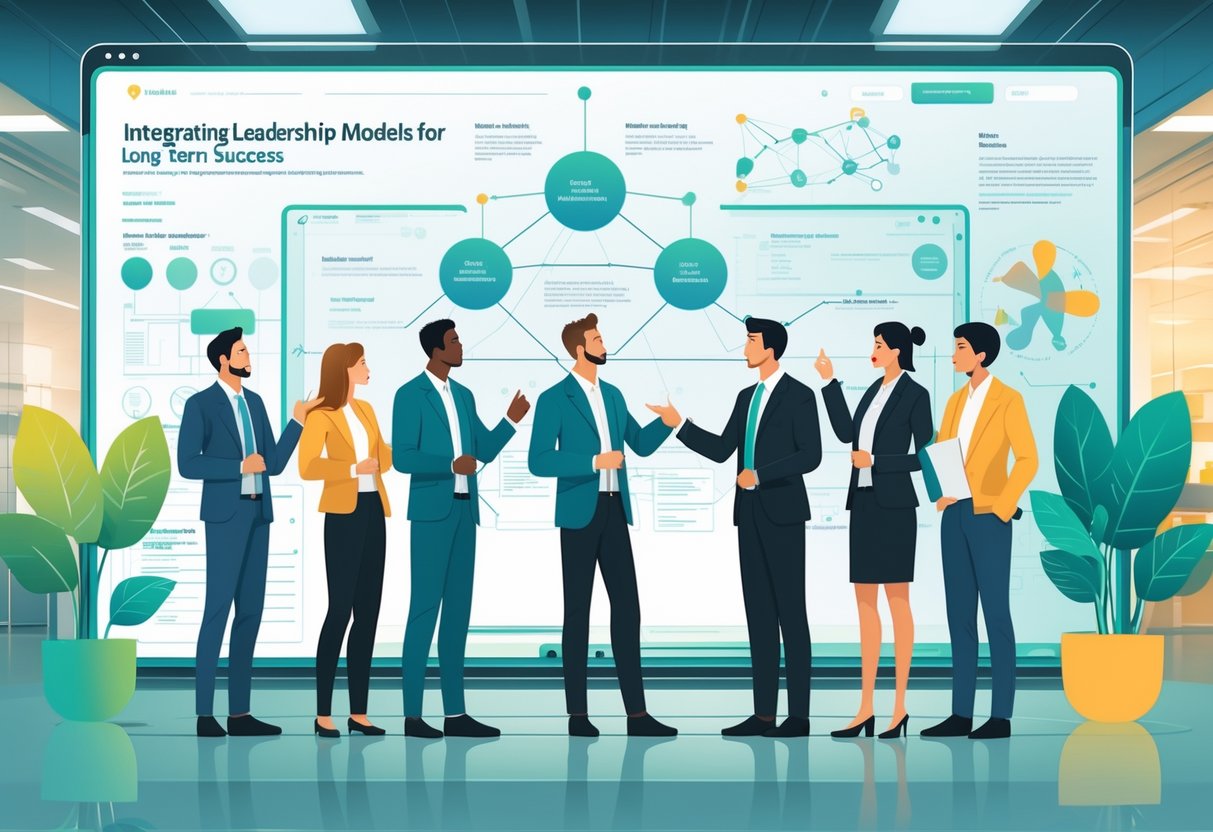
Tech leaders who build adaptive mental frameworks and align them with organizational strategy create measurable advantages in team velocity, retention, and technical debt management. Sustaining these gains requires deliberate model evolution and continuous calibration against competitive pressures.
Evolving Leadership Mental Models
Mental models in tech leadership must shift as systems scale and market conditions change. Leaders who actively refine their decision frameworks avoid cognitive lock-in that causes teams to repeat outdated patterns.
Engineering leaders at high-growth companies track three core areas when updating their leadership models:
- Architecture decisions that affect multi-year roadmaps
- Toolchain selection that impacts developer productivity
- AI integration strategies that reshape product capabilities
Companies that integrate systems thinking into leadership development report stronger innovation outcomes and team agility. This approach helps leaders see interdependencies between technical choices and business results.
Top CTOs build internal frameworks to evaluate trade-offs systematically. They test new models against real engineering challenges before rolling them out team-wide. This reduces the risk of adopting frameworks that sound good but don't work in production environments.
Sustaining Competitive Advantage
Tech-driven organizations need leaders who balance short-term execution with long-term exploration. This balance directly affects how teams handle technical debt and maintain velocity during rapid growth.
Engineering leaders sustain advantage by:
- Benchmarking tools against objective performance metrics
- Building decision models that account for cost profiles and scaling limits
- Creating feedback loops that surface architectural issues early
Data-driven decisions become central when teams grow beyond 50 engineers. Leaders need frameworks that help them evaluate which systems to rebuild and which to maintain. Without clear models, organizations accumulate debt that slows every subsequent release.
Fortune 500 CTOs regularly reassess their leadership frameworks against emerging patterns in cloud infrastructure, AI tooling, and developer experience platforms. They avoid recurring traps by documenting what worked, what failed, and why. This institutional knowledge becomes a competitive moat that new market entrants struggle to replicate.
Wake Up Your Tech Knowledge
Join 40,000 others and get Codeinated in 5 minutes. The free weekly email that wakes up your tech knowledge. Five minutes. Every week. No drowsiness. Five minutes. No drowsiness.